

It doesn't matter.
Any available data on a film's budget, especially credible breakdowns, is what's appropriate for this thread.
The idea is to see what others are (reported) to be doing to use as a reference model for what we could/should be doing as a self-check. "Compared to peer and non-peer filmmakers or the industry, am I spending too much money on X and not enough on Y?"
http://abovethelineproducer.blogspot...budgeting.html "Though movie studios are reluctant to release the precise details of their movies' budgets, it has occasionally been possible to obtain (clandestinely) details of the cost of a films break down.
And that's great and wonderful and all.
Then I find another article that clearly shows the major studios are playing a completely different ball game than many of us in the PONY league.
http://abovethelineproducer.blogspot...financing.html "Consider Paramount's 2001 action flick Lara Croft: Tomb Raider. On paper, Tomb Raider's budget was $94 million. In fact, the entire movie cost Paramount less than $7 million. How did the studio collect over $87 million before cameras started rolling?
First, they used the German tax-shelter gambit. Loopholes in Germany's tax code are responsible for a good portion of Paramount's profits—an estimated $70 million to $90 million in 2003 alone. Best of all, there's no risk or cost for the studio (other than legal fees)... In the case of Lara Croft: Tomb Raider, Paramount sold the copyright to a group of German investors for $94 million through Tele-München Gruppe, a company headed by German mogul Herbert Kloiber. Paramount then repurchased the film for $83.8 million in lease and option payments. The studio's $10.2 million windfall paid the salaries of star Angelina Jolie ($7.5 million) and the rest of the principal cast.
[Second], Paramount made some more preproduction cash by taking advantage of the British government's largesse. To qualify for Section 48 tax relief in Britain, the movie had to include some scenes filmed in Britain and employ a couple of British actors. Given Lara Croft's peripatetic plot, neither condition presented an artistic problem. Again, Paramount entered into a complex sale-leaseback transaction, this time with Britain's Lombard Bank. Through this legal legerdemain, the studio netted, up front, another $12 million—enough to pay for the director and script.
[Third], To pay for most of the rest of the movie, Paramount sold distribution rights in six countries where the Tomb Raider video games were a big hit with teenage boys. These pre-sales in Japan, Britain, France, Germany, Italy, and Spain brought in another $65 million.
Through this triple play, Paramount earned a grand total of $87.2 million. [Fourth], The remaining budget—less than $7 million—would be covered by licensing the film's U.S. pay-television rights to Showtime (a network owned by Paramount's corporate parent, Viacom). At no cost to its treasury, Paramount launched a potential franchise—don't forget that sequels can be financed with the same "risk management" techniques."
Some of these techniques we might be able to use creative variants of.
Point is, the studios aren't just being dumb and lazy putting up 100% of their own cash outlays and Humpty Dumptying out to the back lot or New Zealand.
Neither should we.
Remainder of budgets available from that article: "Though movie studios are reluctant to release the precise details of their movies' budgets, it has occasionally been possible to obtain (clandestinely) details of the cost of a films break down.
Terminator 3: Rise of the Machines
Story rights (Carolco and Gale Anne Hurd): $14.5 million
Screenplay: $5.2 million
John D. Brancato & Michael Ferris: $1 million
Director (Jonathan Mostow): $5 million
Producers: $10 million
Cast: $35 million
- Arnold Schwarzenegger: $29.25 million + 20% gross profits
And if you're not paying attention, these are only production budgets/expenses.
They do not include P&A which may easily equal or exceed the production budget ($150m), listed below as "DISTRIBUTION FEE" @ $211.8m and "TOTAL EXPENSES" @ $191.8m (cumulative):
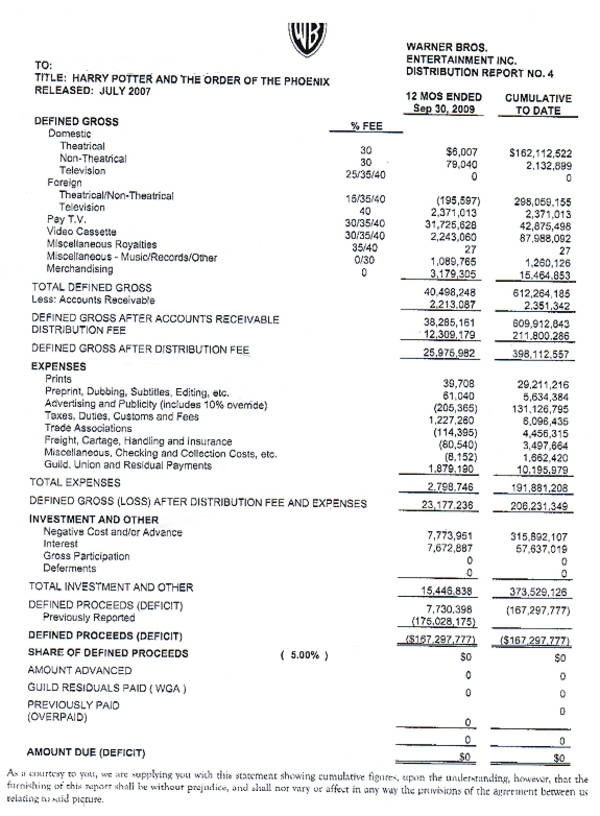
Independent Film Profit Probability http://abovethelineproducer.blogspot...obability.html
(Formatting changes for clarity by myself) "According to the Sundance Institute, the total number of U.S. feature films submitted to the festival was:
1,920 for the 2010 festival,
1,905 for the 2009 festival, and
2,021 for 2008.
Taking an average of these three years we arrive at
1,949.
At any one time, there are about 1,949 U.S. films waiting to be picked up for distribution. This assumes, that all applicants to Sundance have no distribution already in place.
Films with no theatrical distribution in place prior to financing (i.e., most of the films applying to Sundance) end up opening at 1,000 domestic theaters or less, if they open theatrically at all.
The 2011 average was 135 theaters at widest (not total), F 76: https://docs.google.com/spreadsheet/...hZDNzMGc#gid=0
"Hence, a good a place to turn for some rate of success analysis is this pool of limited opening films (specialty films).
The definition a specialty film is any film that opened theatrically at 1,000 domestic venues or fewer, “domestic” meaning the U.S. and Canada.
There were 286 English-language specialty films released into theaters in 2009 (and about 11% had studio financing). Using this 286 number as an approximation of U.S. specialty films, we can examine how they did and come up with a rough probability for turning a profit.
Of the 286 specialty films released in 2009, 52 English-language specialty films appear to be headed for a profit, with the rest not likely to make back their investment.
Films produced 2009 (1949)
Films distributed in 2009 (286)
Films returning a profit in 2009 (52)
Profit probability (2.7%)"
This biz ain't easy.
Cable Channel Strategy http://abovethelineproducer.blogspot...-strategy.html "1. Today’s most typical cable strategy is built entirely around profit maximization utilizing affiliate fees. If you own a cable channel, your goal is to develop one or two key, hit programs, and fill the rest of the linear lineup with very inexpensive content. The “hits” make you a “must have” for any cable or satellite carrier – granting you the right to ask for fees. Too many hits drive up costs.
2. ... affiliate fees are the primary revenue stream that funds today’s mainstream television content development.
In 2009 DirecTV paid approximately $37/sub out of an ARPU (Average revenue per user) of $85/sub, to content owners for programming costs (i.e. affiliate fees).
In this case, affiliate fees represent roughly 43% of total revenue for DirecTV.
Similarly for Comcast, estimates are programming costs at 37% of video revenue (Comcast has high-speed data and voice revenue that are separate).
These are just two examples, but to give you a sense of scale these numbers represent around $7-8 billion/year each for Comcast and DirecTV.
The aggregate fees of all content providers are approximately $32B per year.
To put things in perspective this is about 33% higher than Google’s annual global revenues including revenues for its advertising network."
For those of you with a smidgen of humility about your made-for-TV product: consider trying to be part of that "inexpensive content" filler.
Just a... realistic thought.
"Entertainment lawyer Bianca Bezdek-Goodloe talked with host Jeff Schubert about raising money for feature films, states that offer tax incentives and a lot more... "
Much of this is beyond the scope of many here (micro-budget is considered less than $4m), but understand the financing principles involved.
Ultra-Low Budget Agreement - Total budget of less than $200,000
Modified Low Budget Agreement - Total budget of less than $625,000
Low Budget Agreement - Total budget of less than $2,500,000
Hmm... I think Miss Bezdek's idea of "micro-budget" is a little Hollywood-studio-version-of-such biased.
"Our on-line promotion (social media/press releases/articles) for “Wake the Witch” really started when we got the VOD deal. This time we’ll do that work beforehand to build an aware fan base that will be looking for the movie on VOD."
"Once we have means by which people can purchase our DVDs, it’s a matter of getting people aware that these movies are out there, which is where Facebook comes in very handy. It’s a great way to generate interest IF you’re willing to put the time into doing so. We make a point to try to keep people interested in the entire filmmaking process from pre-production all the way until the World Premiere. "
"As a writer I’ve taken the lesson that “films are for the audience and not for me” and worked to progress beyond work that only appeals to my strange tastes."
Watched your URLs in the threads above. Nice material. Good incite into "MONEY" productions... even for someone who has no money but wants to create & play in the rich man's art scene... Keep the URL's going RAYW. Even though I have heard much f this before, I will keep watching and learning -- it is why I dwell in the realm of Indietalk. A+ thread, RAYW.
"Entertainment lawyer Bianca Bezdek-Goodloe talked with host Jeff Schubert about raising money for feature films, states that offer tax incentives and a lot more... "
Interviewer is a congenial enough "personality-heavy" dork.
The producers really reeled in a smart cookie guest, here.
NYU Professor & entertainment attorney.
It's kinda embarrassing to listen to the IQ difference between these two.
Q. What are some of the ways filmmakers can raise money to make films?
A. None are easy, all are difficult in their own right.
There is no magic bullet. All films financed differently. What ever works. #1. Equity, AKA cash. A high net worth donor, collective of investors, a company that wants to "come across brands" by providing cash.
Equity is used to secure a pay or play individual to get the project some serious traction.
A "pay or play" (PoP) http://en.wikipedia.org/wiki/Guarantee_(filmmaking) is when a talent, actor/director/producer, commits to the project by being contractually obligated to being paid whether the film is made or not.
The full amount is not placed in escrow, but a percentage of that amount is negotiated to be placed in escrow.
Catch 22: How do I get the star if I don't have the money? How do I get the money if I don't have the star?
- Pray
- Beg, borrow, and steal
- Find a star on the precipice of producing or directing and appeal to that motivation. Offer or give them production or director credit as an "in-kind contribution." http://en.wikipedia.org/wiki/Payment_in_kind . This approach is a direct work-around of the talent's agent/broker - it does generate some friction. MY interpretation of her reaction to creative stunts to "persuade" a talent into a PoP agreement was that it was "cute" but not very professional. Just my opinion.
100% funding through equity is fantastic, but may take forever.
She suggests going about the the process to have (private) equity only be about 30 -40% of the film's budget.
Audience Question/Statement: Raining money for indie films is depressing.
Response: Filmmaking is not a poor man's sport, much like yachting.
You have to put in that work, and the ability to raise equity.
It's not easy. You can't be bashful.
@ 7:15 You don't ask, you don't get. That's the business.
Raising equity gives away ownership.
@ 7:35 There are other ways of raising financing while maintaining creative control and ownership.
@ 7:40 #2. Tax Credits
Other nations use government tax benefits and subsidies to bring in film production money for trickle-down economics.
@ 8:47 U.S. govt. began with Hawaii and Louisiana to a current 38 states, there's a Federal incentive for filmmakers to exploit these opportunities, this is money you can get or get certification to qualify for rebates to get the benefit without giving away backend for participation (ownership).
@ 9:05 #3. Pre-Sales
Audience Question/Statement: Can you explain completion bonds?
Response: @ 9:38 Like an insurance blanket that says for 2-3% of the budget a [third party] company will step in, monitor progress, and if a built in contingency is exceeded they will step in to complete the film - although perhaps not at the same quality or aesthetic eye you wanted - but at least it will be finished, in the can, and have the opportunity for distribution.
@ 10:20 Q. Reasons why you may not have a bond-able film or can't get a completion bond?
A. - You don't have a bond-able director.
- The director doesn't have the experience.
- The director hasn't worked in that medium before.
- Budget "doesn't make sense." Ex. The below the line or above the line is too heavy, something in the formula doesn't work and they don't want to take the risk to finish it because then they will be out-of-pocket [paying] for it. http://en.wikipedia.org/wiki/Below_the_line_(filmmaking) http://en.wikipedia.org/wiki/Above_the_line_(filmmaking)
This sends a message to investors you may not conclude
Audience Question/Statement: What do you feel about iTunes-like self distribution?
Response: @ 11:05 She doesn't work in that distribution mechanism. IOW: predominantly broadcast and theatrically released studio distribution, due to budgets.
Not knocking it. Just not her niche.
@ 12:15 Blind Calls & Lead Lists
Please, please, please do not cold call.
@ 13:12 With equity financing, cold calling is in violation of securities laws. It's [viewed as] a scam unless you have a public offering, requiring an expensive and cumbersome process.
For the budgets they're considering ($millions and $millions) there's just no need for cold calling or public offering.
@ 13:35 Private placements, when raising private equity you have to go through.
- Active Investors. If one or two they will be actively involved in every step of the process, will be on set, they're going to be engaged.
You can enter into an investment agreement with active investors.
- Passive Investors. Require a PPM, private placement memorandum, a CYA document should anything go wrong the PPM protects yourself by disclosing all the risks with filmmaking. Part of the PPM requirement is that it is not a public offering and you're only going to be soliciting money from people you know that you could verify that they have the [informed consent] to enter into a high or higher risk investment and understand what's at stake.
@ 14:57 Trifecta of Documents: PPM, Subscription Agreement, and... haven't gotten to it (or they forget about it!) Atty drafted PPM: Explains the risks, market, demographic, the genre, people attached, expectations of what the film may monetarily make, including that it may make nothing. Subscription Agreement: Allows investors to subscribe to shares or securities in the company that owns the copyright that will enter into distribution agreements, that will then through exhibition, tickets and sales generate money.
@ 16:47 Raising private equity (PE) isn't a complicated process, it's just a specific process about how to go about raising that PE.
Gotta go!
Sorry!
Will resume this ASAP, but there ain't no telling when that'll be. Today. Tomorrow. This weekend. I dunno.
348
This is a good interview.
I've got some sapiosexuality goin' on with this chick!
Welcome to the film business people. The normal need not apply.
Yeah, no doubt.
ALLLLrighty...
Where wuzeye... ?
457
@ 17:20 [For private equity (PE)] you can't solicit from more than 35 non-accredited investors depending upon if you're raising $1m up to $5m, or $5m and over.
Accredited means these investors have:
- >$1m net worth in net assets (Net Worth = Assets - Liabilities)
or
- in the last two years generated revenues (AKA income) >$200k, or jointly as a couple >$300k.
@ 17:45 This criteria is in place so that if things go wrong and the investor says "I wasn't forewarned" your defense is "But, you were. You saw it in bold red in the PPM, and you proceeded anyway. And so you proceed with caution."
@ 18:10 Audience Question: Do you like indie movies better since you worked your way down to them, and if so "why?"
A. Yes. They're more interesting from a creative perspective. [Because the German government changed the law] suddenly it became a more interesting landscape to focus on raising equity and non-equity funding through independent films because its like a bigger jigsaw puzzle to me to put together.
@ 18:47 Also, for the filmmaker you goto the studio, you bring them a project, if they like it you become a paycheck player, they pay you your producer's fee, and that's it. [The studio has] creative control, they have ownership, and you're done. From my perspective, as a producer and financial packaging producer and an attorney, it's a helluva lot more fun to piece together all of these unquantifiable opportunities as opposed to just knocking on the door of studio executives and begging for money. That seems to be a considerably more personal-professional answer than the one I believe the audience member had in mind, likely being more towards "Do you enjoy WATCHING/EXPERIENCING indie films more than studio films?", which she either politely sidestepped or is too focused on the subject of the show and what she has to contribute to that: independent film financing. Not if she like indie films more or less because she now puts together financing packages them, IMO.
@ 19:24 Q. How do you feel about social networking sites to put up your new film project and raise money through our site, you put up a trailer and synopsis, and people can invest, and when you hit your [target $$ amount]...
(He's referring to KickStarter & IndieGoGo, and I don't think her answer reflects a fluent understanding of how those sites actually work.) A. The same principles apply. (No. They don't.)
How can you know individuals that you're basically soliciting online? You don't know them, and therefor you are in contravention of Reg D, [securities and exchange commission] federal securities laws, and you're just begging for trouble. I'm pretty sure she isn't aware of the often, relatively to donor income, insignificant amounts these donations are which I believe she's viewing as investments.
Donation. Investment. Ain't even the same thing.
@ 20:05 Use that as a promotion tool, but not as a financing tool. Yeah. If you're raising a few million or even a few hundred thousand dollars for your indie film, maybe.
The scope of a few thousand dollars for most KS/IGG budget goals is waaaaaaaay below what she's talking about for her professional work.
Her advice is FINE if you're trying to finance >$1m to $5m for your indie film.
Her advice is... incorrect if you're just trying to scratch together a few hundred to a few thousand dollars for your indie film.
@ 20:13 Q: Tax Credits. There are certain states in the U.S. where it's better to make films than others. Why? And which ones?
A: There are currently 38 states which offer some kind of a subsidy, credits, or rebate.
Louisiana most people know about, it's one of the more complicated ones to qualify for.
Massachusetts & Connecticut are lucrative.
Rhode Island is a good one.
New Mexico.
Florida.
Hawaii.
@ 20:56 Q: If Louisiana is one of the most difficult one what might be the simplest?
A: None of them are "easy" and none of them are a killer.
The hardest part is timing, because how most of them work is you get into the queue, you get in line, submit your application, you have to get your ducks in a row, submit your budget breakdown, and give them a date by which you will start production.
And if you do not start, and every state has its own unique specifications, most states, if you don't start within 30 days before or after that date, you loose your place in line.
Actually filling out the application that's just heavy lifting a lawyer can do that for you, it's not brain surgery.
@ 21:53 It's just really being sure that the project, when you make your submission, it's kinda the last step, kinda the lowest hanging fruit in financing, but if you screw up the timing you lose your ability to be able to collect on that tax credit.
@ 22:13 Q: How's the best way to find out which state offers what? Is it a state website or one central website?
A: You can google the state film commissions.
But what I would do is there are a number of, the codicil of how do you get to the money, what I was talking about Connecticut, it's 30% credit there, but you're not going to get 30% of your budget.
@ 22:36 How it works is you can wait and spend the money, wait for the state forensic audit to make sure you actually spent that much and you get your certificate, and then you can either use that certificate or sell it to someone for 100 cents on the dollar.
But what good is it to you then if you need it now to put it towards your budget?
@ 22:54 So, what you do is contact a tax credit broker, if you've patch-worked together your production correctly with the other financing aspects, then they will monetize that tax credit in advance, not at 100 cents on the dollar, but at competitive rate, depending upon state by state, is 70 to 75 cents on the dollar.
@ 23:20 That's still not really getting 75 cents on the dollar. You're getting a 30% tax credit in Connecticut from 75% on average of the qualified expenses in your overall budget.
So, 30% of 75% discounted by 75 cents on the dollar will amount to about 15% of your budget.
I'll come back later and knockout the explicit math on this.
Someone remind me if I forget.
@ 23:43 Q: Qualified expense means could be anything. Salary for crew... ?
A: It's different state to state.
Some state limit it to flights into the state, others by flights out of the state.
There's a million different nuances.
You can contact your film commission for this information.
Or call a couple of tax credit brokers, have them create a bidding war for your production, they will give you all the information, they will do your homework for you because they want your business.
Have them provide you with the most up to date opportunities on state by state laws.
"The investigation was sparked when the Department of Revenue spotted suspicious tax returns connected to “The Lightkeepers” film, in which withholding taxes hadn’t been paid to lead actors. That discovery prompted the DOR to dig deeper into the tax credit application, and to eventually refer the case to Coakley’s office.
Coakley’s staff said Adams reported that more than $17 million in expenses were eligible for credits on “The Lightkeepers,” prompting an award of $4.2 million in credits. But prosecutors said expenses were either fictitious or inflated, resulting in an overpayment of $3.6 million. For example, prosecutors said Adams reported that actor Richard Dreyfuss was paid $2.5 million, when in fact he was only paid $400,000.
Similar problems were found in the tax credits that Adams received for “The Golden Boys,” which he shot before “The Lightkeepers.” Prosecutors said Adams benefited from an overpayment of $1.1 million for tax credits related to that film."
LOL!
Goodness.
Whata moron: http://www.imdb.com/name/nm0010871/bio "Adams attended Harvard University, majoring in history. After college, he worked in politics, including two gubernatorial campaigns, a race for attorney general, and two presidential campaigns."
Looks like the good citizens of Massachussets dodged several bullets on those!
@ 24:34 Studio Q: What has been the most difficult challenge you've personally had to go through with film finance?
A: Because I do this all day every day the financing isn't the hard part.
@ 25:00 I take on projects that I know I can raise all the financing for if I'm producing them.
One project called "August and Everything After" With Pierce Brosnan and written and directed by J. Mills Goodloe...
(J. Mills Goodloe http://www.imdb.com/name/nm0328987/bio
I bet it's her husband.)
... and we had everything. We had the equity, debt, the right sales agent, the tax credits.
But we could not cast the female lead within the time we had allotted before the tax credits would fall out.
That was a hurdle I couldn't surmount.
But, that's the casting process; not really the financing process!
@ 25:51 Q: You represent/work with both sides. You work with studios, actors, directors, investors, tax credit brokers, step financers providing advice to everyone. If a filmmaker makes really low budget film, $50k to $100k range, gets some good write ups, press, maybe a few festivals. Now, wants to make his or her next film in the $500k to $1m range, wants to grow his or her career. Do you have any advice for that particular type of filmmaker?
A: First of all, [with any of these price ranges] my question is how did you arrive at that? The jump? That next number?
@ 26:49 I find the problem most filmmakers have is they have a number that gets stuck in their head. That they haven't "made it" until they've made a film that's $5m.
The way to arrive at your budget is do your breakdown of your scripts, see what your drop-dead number is below the line ( http://en.wikipedia.org/wiki/Below_the_line_(filmmaking) ), and really that's your budget.
And if you can get one talented, commercial, actor on board for however much you can get them - suddenly! - THAT'S your budget. (New Budget = Below the line costs + actor fee.)
@ 27:24 You get your two leads then basically you goto a sales agent and say "How much can you sell these guys for?"
If that number is greater than the number you have to pay them then - fantastic. You've done something right.
And if you're not getting your sales estimates in excess of what you will have to pay your talent then it's not working. The talent isn't bringing the value.
@ 27:53 ... you're paying... for talent that will bring butts in seats and will make enough money to cover the budget.
@ 28:00 Jeff Shubert: I think a good point to be made here is if your estimate after your talent is attached doesn't exceed your budget then the budget is too much.
(GD, this guy is sharp!) A: Absolutely. You need to re-tool. You need to re-cast.
@ 28:11 Q: So, where do those estimates come from? How do you evaluate what a star or talent brings?
A: Foreign sales agents.
Different foreign sales agents of varying degrees of reputes specialize in different genres and actors, they sell to particular buyers.
@ 28:34 So, if I were a filmmaker with a great script, and based on my $50k film that perhaps (bemused smile) didn't get widely released, I'm using that as my reel to get investors to show them I have the right stuff, not loose their money, I try to circulate [the film] as widely as I can and try to get someone attached, then bring it to the sales agent to say "Hey, I'm serious. I've done this much of my homework. I haven't cast wide. I need your advice on who do you think can help me sell this project by."
Then you try to get that talent.
@ 29:15 Q: Have you ever run into a situation where a package has been put together and a producer or director thought they had bankable cast, but they really weren't? Because they were like a low-level sitcom star or on a dramatic deal here, but they have no bank in foreign territory, and that's such a big part when we're talking in the $1m to $5m range that you'd really have to make your money in the foreign market.
A: Happens all the time.
@29:39 And it happens because filmmakers don't approach the sales agent early on in the process.
Because you have to know YOU'RE not selling the film.
You're sending... you're outsourcing it to a specialist to sell the film. And I would want to know who that seller can sell!
So, I won't go to someone who specializes in period pieces if I'm doing a scifi.
I'm going to find out a slate of what a foreign agent has sold, and I'm going to try to get the actors that have sold before, because if they've sold them well they'll do it again.
And I kind of reverse engineer what my budget is based on what they can get for it.
@ 30:19 Q: Are these foreign sales agents approachable by independent filmmakers, let's say when they complete their script?
A: No. (Laughs)
Obviously it's a short list. I don't play favorites. I advise filmmakers to try to find inroads to... whichever foreign sales agents the banks will believe in, believe that they are credit worthy, because I can give you estimates, [anyone] can give give you estimates, doesn't mean [they] can sell it, doesn't mean the bank will believe [them].
So, I can recommend highly reputed foreign sales companies... (he interrupts her)
@ 31:00 Q: And typically, when is the time to approach [the foreign sales agent]? And are they receptive to...
A: (she interrupts him ) The way to get to them is... that's the job of a good producer. A producer has these relationships or a producer that can actually lure a director that can lure the talent.
And then you walk in with a package to a foreign sales agent and if they sense some opportunity to make money of course they're going to consider the project.
@ 31:20 Or if the foreign sales agent had a good experience with a particular producer they are prone to working with them again. That's WHY you're paying a producer. That's your entré.
So, try as a writer and burgeoning director to staff yourself up with the right team to open those doors.
@ 31:39 Q: I was reading in some of your material you talking about tier one and tier two foreign sales agents. How many are in that tier one category?
A: It's a short list and it changes around all the time, because... a lot of companies merged and the marriages weren't very good, so a lot of companies dissolved and management has jumped ship on a couple companies.
@ 32:07 Summit is as good as they get. http://en.wikipedia.org/wiki/Summit_Entertainment
Their sweet spot is $20m. They have their own fund so it's very difficult to get them because they tend to sell their own product.
@ 32:19 Mandate has been acquired by Lionsgate. http://en.wikipedia.org/wiki/Mandate_Pictures http://en.wikipedia.org/wiki/Lionsgate
Same kind of concept there; it's hard to get them interested in a project that's not one of their own.
@ 32:28 Hanway is a wonderful company. Kathy Morgan International is a wonderful company. Myriad, they know what they're doing. http://en.wikipedia.org/wiki/HanWay_Films http://www.imdb.com/company/co0011323/ http://www.imdb.com/company/co0033226/
These aren't "my buddies." These are companies that I know that I can go to a debt financer and say "Can I cash-close these pre-sales, and can you also provide GAP and super-GAP based on the open territories of they say that they can sell?"
And if they can put the seal of approval on it then that's great with me.
@ 33:01 Audience Q: How can I tell if your entertainment lawyer rep is legit?
A: That's kind of speaking to two different hats.
You can tell your entertainment lawyer is legit by doing your due diligence; do your homework.
Ask around, see their reputation, see what films they've done, who their clients are, and if you like them. If their contentious then it might not be the right fit.
And then the sales rep or producer's reps and attorneys are mutually exclusive of each other; they're not necessarily the same person. They can be, but the producer's rep tries to sell a film typically in the domestic market at a festival.
A foreign sales company can also sell [films] domestic, but is typically engaged to sell foreign territories to the best buyers you can get the most money out of for those distribution rates.
@ 34:06 Getting back to why I think foreign sales reps are going to stay in foreign markets and not come over to domestic is because producers are getting smarter and they're learning how to work the relationships so they can plan their own domestic distribution deals, which actually my expectation is that's the job of a good producer.
And therefor, producer's reps are becoming a thing of the past because producers are doing their job better, they're getting savvier.
@ 34:39 Q: So, if an independent filmmaker completes their film, a producer's rep: good thing/bad thing? Or... ?
A: Unnecessary. Q: Because the sales agents and the distributors are readily approachable without them?
A: Yeah. If you've carefully constructed your package, the script and talent, then you don't really need to pay a commission to get your domestic deal. You can take it to the studios directly.
Or then you can pay that commission twice, you just pay that foreign sales agent that can provide you with that entré to studio distribution.
"Watching Tom Hanks and Julia Roberts in Hank's unfairly poorly rated directorial debut Larry Crowne (7/10) also got me watching Tom Hanks and Julia Roberts again in the more highly rated Charlie Wilson's War (8/10).
Philip Seymour Hoffman's character Gust is a hoot. Love it.
And just for fun & games: Would you rather make
A) a poorly received $30 million film that made $68 million in the box office, or...
B) a well received $75 million film that made $119 million?"
What number does are these above equations missing?
Perhaps for us non-studio filmmakers the equation would look more like :
Return On Investment = (Production Budget + _____________) / Distribution Revenue
This same principle applies to any of our non-art-for-the-sake-of-art attempts at monetizing our film products.
Exchange "millions" for "thousands" in the example above:
And just for fun & games: Would you rather make
A) a poorly received $30 thousand film that made $68 thousand in distribution revenue (to you, of course), or...
B) a well received $75 thousand film that made $119 thousand ?"
I think most would opt for the second, 75 that brings in 119 and is well received. There's more money and a larger audience (hopefully helping your chances on your next project) even if more is spent up front.