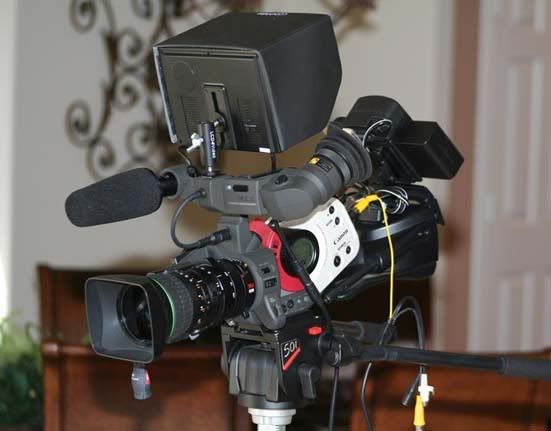

View Full Version : The Prosumer Myth is bad
clive 03-05-2008, 07:30 AM OK, I know I'm not going to make any friends with this thread, but I really need to share my thoughts and feelings about the mythology of Prosumer camcorder film making.
The basic problem with cheap prosumer camcorders is they give both too much and too little to make a movie.
They give too much in terms of formats: DV/Dvcam/HDV/HD720p/DVCPro50/DVCProHD etc etc... and yet neither the chips or the optics are good enough to serve the formats... and because the price you pay for a cheap camcorder is HAVING to use the sub-standard lens they provide, there is always going to be a huge difference between what those camcorders promise and what they deliver.
Not only that, because they are always light weight and either won't shoulder mount... or when they can, don't have the right kind of balance for hand held camera work... they present a set of limitations, which isn't out weighted (IMO) by their cheapness.
One of the common arguments made by DV film makers is that the cheap camcorder gives them the opportunity to learn how to make films without having to invest huge amounts of money.
However, this arguments doesn't hold up for a number of reasons:
Firstly, when people talk about the maths of DV production they are talking about $3K for a prosumer camcorder, $2K on a computer and editing software, and about $2K on other bits and pieces collected over time. Seriously, by the time you've added on some fancy pluggins to make the DV look like film, a 35mm adaptor, a Matte box, a cheap steadycam, some lights, a decent mic, a boom pole and three hundred books on how to make Hollywood movies on DV cams, then you're easily looking at another $2K.
So, all in all you've invested $7K on equipment that almost, by isn't quite good enough to do the job.
Secondly, working on prosumer camcorders with no crew is completely different from working with a professional crew and equipment. Only about 30% of the skills acquired shooting on camcorders translates over to working with professional kit... even less when it comes to camera operating or producing.
So, actually the skills a DV camcorder film maker acquires don't relate to the industry at all... they are not good learning tools.
If we go back a few years... then indies worked in a different way (this is more true in the UK and Europe where there has never been a market for home grown direct to DVD movies)... basically, a film maker made some short films... either on digital or on film... saved up their money and honed a really good short, which they shot on 35mm with a name actor... and they they used this demonstration of technical competence to chase down a budget large enough to shoot their first feature film... on film.
Every step of that process they worked with the best professional crews they could... they shot less often... but they invested more time in development of their ideas and their scripts.
Now, professional HD equipment and film cameras are still available for us to use... not always at a huge price... there are skilled professionals out there who want to work on interesting projects.
Primer was shot, on film, for $7000.
The very practice of working on film... or on professional HD means you have to prepare your story and your shoot. You can't just pick up you camera and waste both tape and time noodling about.
What I've seen in the indie world isn't the explosion of new talent into the industry... but instead a ghetto mentality... "we make films on camcorders... we only do it this way... we think every new format development or gadget is going to allow us to live the dream of making movies, without actually having to make movies."
Instead of seeing hundreds of breakout movies hitting the cinema, made with the advantages of new technology, instead I see more and more indies going from film making as a career to film making as a hobby.
Somewhere in the last seven years the possibilities of new digital technology destroyed the indie film scene... a scene that has stopped talking about distribution deals... a scene that has stopped talking about budgets... a scene that has replaced movie making with talk about the new cameras.
And we've let this happen... what the hell went wrong... and when did the ambition to make real movies stop being a part of indie film making.
Somewhere the difference between being a film maker and being an indie became a yawning chasm... and it all happened in the last five years.
I do have a solution though... stop making films, stop buying equipment... work out what movie you really want to make and spent the next year writing it... then make it with a professional crew on either film or at the very least the Panasonic Varicam.
Either that...or somebody make a film on a prosumer camcorder that gets an international cinema release and some decent press.
oakstreetphotovideo 03-05-2008, 08:42 AM I agree with you Clive on many points, except the point about dollars. Due to the cost of entry, I can make money and pay for all of my equipment with a small business, shooting commercials and events, then I can work with a talented group of individuals to produce something that we're all proud of, without having to spend a lot of our own money, or sell our souls to a distributer. If we come up with something great that eventually gets distribution, then that's wonderful. If we don't we've had an opportunity to collaborate on creative expression that is priceless.
I guess my point is that I, for one, am not trying to get rich from my creative endeavors. I'm making a decent living doing semi creative commercial work, and there are lots of local film festivals that wouldn't even exist if it weren't for inexpensive technology, where I can show off my creativity, which means more to me than a million dollars.
Furthermore, cheap cameras allow me to shoot video from the bow of my kayak and other hazardous places without toting 60 pounds of gear or risking a huge investment. I've seen indie movies made in remote places (mountain climing, remote ocean kayaking, etc.) that would not have been possible with a 35mm rig.
I'm in your camp on some points. I do believe that "cheap" has given rise to a rash of low quality work that has obscured the occasional short with high production values. I must say, though, that some of my favorite movies were made on a small budget. It's been said here, ad nauseam, that the camera does not make the movie. Do you really need to require a big budget to work hard on your script, look for good/name actors, have high production values, good light, etc? I agree that the professionals are accustomed to more robust tools, but that is just another challenge for the DP, it's not a reason to throw away your prosumer camera.
Just to avoid sounding like I'm in total disagreement, let me reiterate, that you are absolutely correct about the rush to buy equipment and start shooting, with nothing more than a loosely defined concept ... hell, I've done it. Maybe it's good advice to stop buying equipment and focus on script/preproduction if your target is an international cinema release. It's a good idea to do good preproduction in any case, but if you don't intend to find a distributor for your film, then a small budget just makes good business sense to me.
Joe999 03-05-2008, 08:53 AM One could argue that there is a viable market for movies shot on digital over film. I am sure it is a given that many to most of these digital theatrical release movies were made with high end digital camcorders, not prosumer camcorders, but as with all technology the quality of digital camcorders will increase according to Moore's Law (http://en.wikipedia.org/wiki/Moore%27s_law) and the prices of such camcorders will become affordable to most of us, meaning digital may become the future of moviemaking. Some of these were shot on prosumer camcorders (e.g Open Water).
Here is a list of theatrically released films shot on digital as opposed to film:
Source: Wikipedia:
http://en.wikipedia.org/wiki/Category:Films_shot_digitally
9 Songs
Able Edwards
The Adventures of Sharkboy and Lavagirl in 3-D
Afrodite Superstar
Aliens of the Deep
The Anniversary Party
Apocalypto
Atanarjuat
Boat
Buena Vista Social Club
Caachi
Caché
Cars
The Cats of Mirikitani
The Cell
Click
Cloverfield
Codex Atanicus
Collateral
The Company
Corpse Bride
Curious George
Dancer in the Dark
Darkened Room
Dear Pyongyang
Dogville
Domino
The Edukators
Ellie Parker
Evenfall
Böse Zellen
Full Frontal
Gabriel
Godzilla: Final Wars
Grindhouse
How High
Hustle & Flow
Inland Empire
The Kingdom
The League of Gentlemen's Apocalypse
Looking for Kitty
Manband the Movie
Manderlay
Me and You and Everyone We Know
Miami Vice
My Scary Girl
New Crouching Tiger, Hidden Dragon
Next
Once Upon a Time in Mexico
Open Water
Pieces of April
Planet Terror
A Prairie Home Companion
Rainbow (1996 film)
The Right Way
Russian Ark
S1m0ne
Saraband
Scarlet Diva
Scary Movie 4
Silent Hill
Sin City
Sketches of Frank Gehry
Sky Captain and the World of Tomorrow
Spy Kids 3-D: Game Over
Spy Kids trilogy
Star Wars Episode II: Attack of the Clones
Star Wars Episode III: Revenge of the Sith
The Storm
Superbad
Superman Returns
The Talent Given Us
Tape
Tears Of God
The Cave
U2 3D
Ultraviolet
Under the Raven's Wing
La virgen de los sicarios
Zodiac
The Zombie Diaries
Joe999 03-05-2008, 09:08 AM Somewhat related, I would have to say that I believe the cheap affordability of digital prosumer camcorders and related equipment (NLEs for home quadcore PCs, etc) is likely giving rise to a rush of wannabe indie filmmakers (I am one of them) who write up a screenplay or acquire one cheap. The story, the screenplay, has not had to pass through the normal filtration process to assure its quality for hollywood. So I think, and this is just my opinion, that there will be a plethora of indie films made because of the affordability of prosumer equipment that lets anybody produce and direct just about any screenplay. But the success stories will come from those indies that have the great stories, the great screenplays. Too often I fear most indies will be made just because their scripts can be made into movies, without going through a screening process.
oakstreetphotovideo 03-05-2008, 09:18 AM It is also worth noting that Hollywood uses a cookie-cutter approach to making movies that they know will be popular in the box office. Just because a movie isn't hugely popular, grossing in the 100's of millions of dollars, doesn't mean it's not a great movie. If it weren't for indie film makers who don't need to gross 100 million to satisfy their investors, we'd have nothing but the same shit coming out of Hollywood, year after year.
Doug
Joe999 03-05-2008, 09:23 AM Replying to my own post, I just have to comment on a purchase I made yesterday. I bought an 8GB usb flash drive, the size of a car key. Now they make them up to 32+ GB but I just bought the 8GB, plan to hook it on a carabiner on my bookpack. Now what amazes me is I was thinking of the 1.44MB floppy disk I still use to store some financial info on, to keep it off my PC or the net. That 8GB little car key flashdrive is about 6,000 of those 1.44MB floppies. That blows my mind. I just can not imagine what sort of digital camcorder technology we will have in 5-10 years out, it just will have to be mind numbing. Red.com (http://red.com) quality digital camcorders will likely be <$3000 ten years from now, seriously.
[QUOTE=Joe999;69103]... as with all technology the quality of digital camcorders will increase according to Moore's Law (http://en.wikipedia.org/wiki/Moore%27s_law)
clive 03-05-2008, 09:39 AM The vast majority of those digital films were shot on Cinealta or the equivalent. A lot of them had multi-million pound budgets.
I'm not arguing against digital... hell, I was one of the early pioneers of HD film making... five years ago people on this forum, who now shoot on HD, were calling me an idiot for predicting that HD would replace film as the indie format of choice.
All I'm making is a personal observation about how cheap prosumer camcorders have effected the indie scene.
georgiahoosier 03-05-2008, 09:47 AM Once again Clive hits the mark, generally there's a ton of discussion about best this best that, film look this film look that.
I'm yet to read "I shoot with a Panaflex on 35mm and am trying to get my film to have the "video" look"
There have been some films done that way, the pioneering work in "deep focus" was Citizen Kane.
Crystal clear from front to back. It would be interesting to see someone shoot a piece in BW on video to give that effect a whirl.
I still believe story is king and should hold sway over equipment and technology (which is what Clive is saying about taking enough time to make sure the screenplay is done to your satisfaction).
If the story is good (or great even) it doesn't matter if you shoot the movie on a Kodak Brownie and clothespin all the pictures to a wheel and look at them through a magnifying glass, it's still a good story.
I purchased old tech DV cameras (original Canon Opturas) because they were dirt cheap, and coming from a background in radio I wanted to experiment with video, put me in the "hobbyist" category for now.
So for the time being I work within the limitations of the camera and create content that will most likely be seen on tv or computer until I build some credibility and then move up into buying or hiring better gear and the people to go with it.
I've always considered myself more a writer than anything, so the access to low priced equipment has allowed me more of an opportunity to see if my writing holds up. The latest and greatest tech stuff doesn't interest me so much at the moment, but in ten years I'll be buying it from people that thought there was something magical about it a decade back. ;)
I really thought the new technologies in distribution and equipment would indeed lead to an explosion in content from independents, but I think Clive is right that the access may actually have led to a lowering in the amount of production. If I missed your points Clive feel free to smack me down.
Being the eternal optimist I would like to think of that as an opportunity. It's a vast unexploited market for well written and well executed productions.
Neil
VPTurner 03-05-2008, 10:17 AM Clive, I agree, and that is my plan. But I can study light, exposure (basic), camera movement, blocking, framing, and editing among other things, without film cameras. And the professional digital cameras are getting very close to the quality of film cameras. Yes, there is still a plethora of data in the analog world that does not directly translate, but there are limits to what the human eye can perceive. I have both an analog 35mm still camera and a digital SLR. For some things, I prefer the analog camera (especially black & white photography). Others, the digital is more convenient and still produces an excellent image. What I love about digital is instant feedback. When I snap a digital photo, I will know right away if my exposure settings were correct or if I need to aim and bounce the light in a different direction. Then I can snap several others while experimenting until I get just the image I want. I guess I'm too into instant gratification and don't want to have to wait for processing to find out whether I missed the mark.
But I understand your point in that I shouldn't need to buy all of those things. I could just rent equipment, hire writers, a Production Manager, DP, gaffers, key grip, script supervisor, assistant directors, costumers, makeup artists, et. al. and just sit back and watch it happen if I were in it solely for the money. But I'm not. I am in it as a creative outlet. And if I do ever get to a point where this endeavor pays more than my day job, my knowledge in all of the other areas of the process would prove invaluable because I could wear many hats depending on the needs of the production. If nothing else, I can watch the machine and know what parts need oiling and what parts need replacement.
And on the costs, I can empathize. The more I evaluate what I have and what it can do relative to what I want to do, the higher the investment. I am about $3000 into obsolete camera equipment. Everything else will carry over (computer systems, C-Stands, tripods, sound recording equipment, flags, lights, etc.).
Considering what that $3000 got me relative to what it would have cost brand new, I'd say I was doing pretty decent all things considered:
http://i5.photobucket.com/albums/y152/CySevans/XL1s_4a.jpg
clive 03-05-2008, 10:55 AM I think it's because I came into indie film making as a writer/director with no technical skills.
So, all of my early films were shot with a DOP, sound guy, first AD, gaffer, and about a dozen runners. I've only acquired technical skills as the industry has developed in the weird prosumer way it has.
I never expected to be a camera operator/sound guy/art director/writer/director/producer/1st, 2nd and 3rd AD/editor (offline and online)/colourist/foley artist and sound designer. (better add 3D animator to that as well, these days)
I learned how to frame a shot/about exposure/about DOF, from my years as a professional photographer... so, I never needed to learn those skills on a camcorder... and the camera operating skills you acquire on a prosumer cam really don't translate to professional cameras. (A fact you really won't appreciate until you knock out the back focus on a professional camera).
The fundamental skills of exposure and framing I can teach to fourteen year old in about two hours... after that it's just practice... something you can do as easily on a good stills camera. And the body memory skills you learn from moving a prosumer camcorder are detrimental to professional camcorder use.
Often as indies we talk about film makers like Rodriguez as a model, but overlook people like Bruce Robinson... who made "Withnail and I" with absolutely no technical knowledge at all. He delegated the entire shooting process, lens choices, shot choices, lighting and sound to professionals, whilst he concentrated on getting his script and his performances right.
Ironically there are a whole world of indies who are making innovative films and acquiring a radically different skill set... you should check them out, they're fab:
Straight 8 (http://www.straight8.net/straight8b.htm)
directorik 03-05-2008, 11:08 AM If you limit the discussion to learning how to use a pro camera. I agree.
However, there is so much more to learning how to make a movie than
learning how to use a camera. I became a camera operator more than ten
years after I started directing - directing semi-professionally. So for fifteen
years ( if you count the dozens of short films I made as a teenager) I
knew nothing about cameras.
Learning about filmmaking a film isn't limited to cameras. So I still deeply
believe that a consumer camera or a prosumer camera is a great tool in
the learning curve.
One of the common arguments made by DV film makers is that the cheap camcorder gives them the opportunity to learn how to make films without having to invest huge amounts of money.
However, this arguments doesn't hold up for a number of reasons:
Firstly, when people talk about the maths of DV production they are talking about $3K for a prosumer camcorder, $2K on a computer and editing software, and about $2K on other bits and pieces collected over time. Seriously, by the time you've added on some fancy pluggins to make the DV look like film, a 35mm adaptor, a Matte box, a cheap steadycam, some lights, a decent mic, a boom pole and three hundred books on how to make Hollywood movies on DV cams, then you're easily looking at another $2K.
So, all in all you've invested $7K on equipment that almost, by isn't quite good enough to do the job.
Here's just a few things one can learn:
Casting and working with actors.
Working with crew.
Scheduling.
Finding locations.
Camera and lights placement to tell your story effectively.
Creative ways to move a camera.
Controlling the set - getting the best out of people and "making the day".
And you can learn all this without spending $7k. You can learn all these
very important aspects of making a movie for much, much less. A $600
camera, free editing software and $200 worth of lights and reflectors. So
I think you can learn without spending huge amounts of money.
And every single one of those things directly relates to the industry.
VPTurner 03-05-2008, 11:25 AM I think it's because I came into indie film making as a writer/director with no technical skills.
So, all of my early films were shot with a DOP, sound guy, first AD, gaffer, and about a dozen runners. I've only acquired technical skills as the industry has developed in the weird prosumer way it has.
...
I am the opposite. I bring all of the technical knowledge to the table. Working in computers all those years, I can build and troubleshoot practically anything, from a gaming system to a high-end server or workstation. Working in computer graphics engineering for a number of years, I play with the oscilloscopes, spectrum analyzers, pattern generators, broadcast TV signal analyzers, etc. As a Home Theater enthusiast, I calibrate my own equipment (sound and video). And the third variable is a love of movies and all things visual. I started out in my younger days studying screenwriting, so I’ve spent several years developing that skill and story sense. What better way to bridge what I was doing in my younger days with what I’ve been doing as a career? Maybe my approach is wrong and I should just focus on one skill. Don’t know yet. I’ll know after a few short video productions. I may not have the patience to work with a full crew, in which case I’d be resigned to writing and/or editing anyway. I am not a makeup artist or a costumer and don’t want to be, so I will need to outsource those duties no matter what.
At middle age, I am exploring my options. One will float to the surface and I will end up where I am supposed to be one way or another. The more I learn about the production process and go through the planning phase on my own projects, the more I think of ways to delegate and who I'll need to ride along with me. There is no way I can do this all alone no matter what my skill set.
Joe999 03-05-2008, 11:49 AM Take a Cenealta $250,000 digital camcorder. Playing voodoo with the cards, it is possible that might sell for $2500 ten years from now. I look back ten years ago and I recall RAM memory sold for $100+/MB. That means the 4GB memory in my personal PC would have a 1998 value of
4000MB => $400,000
Amazing. I get what you are saying. But if such almost film equivalent digital camcorders become affordable, indeed almost cheap, in ten years, film might become extinct.
The vast majority of those digital films were shot on Cinealta or the equivalent. A lot of them had multi-million pound budgets.....
clive 03-05-2008, 12:18 PM Rik, I do understand that you learned how to do those things by making films on DV... but actually the very skills you're talking about are the skills that the new generation of film makers aren't learning, simply because they've got camcorders that allow them to 85% of the process without technical support.
As a result of this they never even consider working with other professionals... and they never acquire the kinds of skills and disciplines we acquired working "old school" but with new technology.
What bothers me is the widening gap between "DIY" indies and the film making industry.
What also bothers me is the idea that a $4K camera can be made to do what a $50K camera is designed to do, if you bolt the right bits on.
There is a growing industry out there of people who benefit from selling that lie, because it allows them to sell books, products, camcorders, half assed steady cam rigs and any number of pieces of kit/software and manuals.
It's a cynical industry that knows there are a million wannabee film makers out there who want to believe they can become the next Tarantino, if they just put the right lens adaptor onto their $2K camcorder.
The scene has become obsessed with the "how to" and has lost sight of the business side of the business. As a result the digital revolution that showed so much promise is dying on its ass.
It's turned too many potential film makers into Youtube content providers; it's become victim of anyone who can see a fast buck to be made from screenplay contest, 48 hour film contest, online film festivals and a million other diversions from the actual task of making films.
John@Bophe 03-05-2008, 01:04 PM It's turned too many potential film makers into Youtube content providers; it's become victim of anyone who can see a fast buck to be made from screenplay contest, 48 hour film contest, online film festivals and a million other diversions from the actual task of making films.
I view this as the most important statement in the thread.
REASON: Unfortunately, this is where our entertainment culture is already headed. Look to the music industry as a mirror example -- 20 to 30 years ago, the cost of producing your own media and getting it into the hands of a wide, diverse market was cost prohibitive. Today, with computer recording equipment and MP3 uploads to the internet, anybody can make a bad recording of poor talent and be heard around the world. The middleman, whose job it is to weed out the mediocre and offer recording/distribution deals to the truly promising -- these guys are becoming obsolete. However the public does not seem to mind. They have an unlimited pool of content from which to choose. The days of one band taking the world by storm are probably over. I would challenge anyone to name a band since 2000 that has captured the fan base earned by classic artists like The Beatles, The Rolling Stones, etc. Does anyone today even have that potential? Sorry if I digress from the true thread topic, but I think this situation mirrors what Clive is saying.
This cheap technology is already out there, and people are already doing what they do with it and flooding the world with YouTube content. That can't be taken back. Its like trying to take pee out of the pool. The world of professional visual content will likely struggle to re-define itself as the music industry has been forced to do.
directorik 03-05-2008, 01:19 PM If a new movie maker never learns these skills, they will not
succeed. You suggested that there is little learning value in
using a prosumer camcorder. I don’t think asking about how to
make their movie shot on a $600 camera look like film is
indicative of that failure.
I take no exception that you are bothered by the widening gap. I’m
not. I am excited for all these “DIY” movie makers. I was one
once. And I tried and tried to make my super 8 movies look
exactly like the movies I saw in the theaters. And when I moved
to VHS I did the same thing. As I learned, I discovered that
what was important was NOT the camera. So will any serious movie
maker.
I have a lot of respect and admiration for people who are trying
to get an excellent image from their $4k - or $600 - DV camera.
I’m envious that new movie makers have forums like this where
they can make contact with people with experience. I didn’t have
anything like that. I had to figure out what I was doing wrong by
trial and error with no professionals to ask questions.
I agree with you that there are a lot of lies out there about this
business. Writers and actors pay “agents” for representation.
Some get burned and quit - some get burned and continue with a
better understanding of the business. Filmmakers are being sold
exactly what you mention. Lens adaptors are worthless, “film
look” software looks to a pro like video with an expensive
filter. Festivals and contests are touted as the answer. Many
movie makers are spending most of their time concerning
themselves about technology and not what’s really important.
No argument there, clive. If every new movie maker who posts here
about “best” camera, “best” software, “best” lens adaptor, made
movies with what they currently have, and made a LOT of them,
they would learn more.
When I was getting started I believed I could be the next Kubrick
if I just had a better camera. Don’t we all go through that? Is
that something new?
I see the digital revolution as still showing a lot of promise and
far from dying on its ass. I see it thriving and being very
exciting!
Zensteve 03-05-2008, 01:57 PM I was going to sum it all up and blame "Teh Youtubes" - looks like it's already mentioned, though. http://www.stevenrichards.com/images/smiley_pac.gif
oakstreetphotovideo 03-05-2008, 04:36 PM I have an analogy from my life that might apply.
Back when I worked as a photojournalist (early 1980's), nobody paid much attention to digital, and 35mm was considered low quality. For professional work, most of us were shooting 6x7cm or 2x2 negatives (120 film) at the low end. At some point, 35mm cameras overtook the "pros" for shooting weddings and such. The professionals with their expensive film cameras and large, external flash units were overtaken by 35mm shooters with on-camera flashes. Quality went down, but the consumer adjusted their expectations. Then came digital, which aspired to reach 35mm quality (what had previously been considered substandard). It was a long time before digital still cameras were arguably as good as 35mm film. Even now, only the best digital cameras come close, in my opinion, but consumers have devolved to accept low resolution digital images as the standard, and with everyone shooting their own weddings, vacations, sporting events, or what have you, the truly professional photo shot on 5x7 sheet film is all but dead.
What is the consequence? We've got millions of images that are shot with barely a thought, that have replaced a few really outstanding images that were produced by the elite photographer with an in-depth understanding of his medium, his equipment, and the art of photography. I'm sure you could argue that millions of snapshots are better than a handful of awesome photographs that cost too much money, but you could also argue that we've watered the industry down to the point where it is nearly impossible to convince someone to hire a competent photographer (if you can find one), because people have lowered their standards to the point where anyone with a decent digital camera and a modicum of skill can produce adequate results.
It would seem that my darkroom skills and knowledge of film are now completely obsolete. I suppose that jades my opinion regarding this "evolution". I don't think anyone will argue that technology is moving forward and giving us "more", but will the new shooters ever become as proficient as we had to be when we didn't get to see the results until our film had been developed and we had at least a contact sheet to look at. We learned to see like our camera/film sees. We had to produce consistent results with no instant preview. I believe that experience makes me a better photographer; even with my digital camera.
To bring the analogy even closer to this thread, I could call this the mega-pixel myth!
Doug :)
EmmaMc 03-05-2008, 06:25 PM I agree with John, I'm thinking that you are taking your frustration about a fading indie scene out on entirely the wrong thing. The problem isn't that technology is cheaper and therefore more accessible, it's that the wrong people are gaining access to it. Half the people out there making films aren't even interested in the process itself, they are concerned with how much the end product will earn them and that shows in their films... Everything becomes half-ass when the mentality is get it done as quickly as possible. Too many people are mistaking opportunity for innate ability and creativity. But i firmly believe that their are people who will benefit from from the opportunity to make a film on a lower budget and those are the films we should be paying attention to.
Spatula 03-05-2008, 07:35 PM Not just teh youtubes, the whole freakin' internet is to blame.
The internet created a decentralization of information... therefore a medium for communication on a global scale. Long distance rates or travel expenses were no longer a hindrance in distributing content... the studios loose control over distribution venues due to digitization and high bandwidth speeds.. the record labels loose revenue because of an abundance of content on the internet... but behind everything is the looming specter of the internet... whereas the studios, networks and labels controlled the advertising medium, limiting it to what censors and screeners select, the possibilities of content on the internet is ENDLESS. I mean, I've seen one of the best features films I've ever seen for FREE from the filmmaker's website (Magnus Opus, and it was on google video a while ago, but try and track it down!), but I've also seen two girls eating each other's shit out of a cup. No boundaries. Not even when you would WANT boundaries.
I agree with Clive for the most part, but I gotta say that I think there's a bit of "traditional thinking" and "old schoolism" jading your analysis. I agree with you about the last 5 years, but I think that it's still an evolving market, and in still in the cocoon form.
I think Bluray, and the former HD-DVD are just distractions to bleed the greedy market of money until the internet is completely monetized, censored, patrolled and controlled.
The internet is the wild west, and with things like Net Neutrality heating up, it's pretty obvious that the big media is after the medium.
In 5 years, if things keep going the way they do, Viacom and AOL-Time-Warner-Microsoft-Mac-Trump-Enron will be making trillions off the internet and putting choke-points on the spread of information. You won't be able to see an artsy short student film without seeing an ad for some diet calorie-free soda that your facebook account profiled you to be in that target marke... and big media will be rolling in money again. From an artist's point of view, it's a big threat...
But in the next five years, all the filmmakers working on web-based content might actually have some profitable opportunities (ad based revenue... there's a few already- Revver, Metacafe) which could be the source of financing for larger projects.
Rather than mortgaging houses, taking loans, or seeking investors, films could be funded by revenue from shorts online. For (interested) filmmakers, this could mean shooting 35/HD, hiring a professional crew, PAYING actors!, name talent and the ability to not have a 9-5 job.
For everyone else, it's more money to waste on crappy films...
But think about it- RIGHT NOW, you can watch feature films online, STREAMING. In 5 years, you'll be able to stream full HD videos to your HD computer on your HD Ipod. Instant gratification. Box Office weekend will be measured by number of downloads, the "ticket" price will cut out a lot of overhead, but international sales streamlined.. roaring profit. Then slap an ad at the start and we're talking BA-JILLIONS.
But that won't happen until big media institutes Net Neutrality... the studios are afraid because if people start regularly getting their movies from the net, they'll be one step closer to online piracy.... aka- why pay when you could see it for free?
So they'll lobby the government to regulate traffic to designated servers where they can control branding, and the means and the message. Then, NBC.com will run fast for all AOL users while Pirate Bay or torrent sites will be restricted. Independently financed competition can be limited on bandwidth, and the consolidation of the world wide web will eventually lead to a rise in corporate ownership of all ideas, which will suck.
So, really our job as indie filmmakers is to barrage the market with as much low-budget *quality* work as possible, glean a huge profit, become independent millionaires, and replace the centralized studios with our own decentralized networks that internationally target audiences through the web... while spending our own oodles of "producer money" to lobby (read: bribe) politicians into obliterating net neutrality and entering the golden space-age of mankind, where we all share the same robot-enhanced consciousness and roam the universe bringing peace and justice and rocking good movies to all alien species.
Until then, I think we're stuck in an industry gridlock, reluctant to change and too decentralized to remain the same.
But as for DV filmmaking- I agree that it doesn't teach the traditional process well, but SKILLS are learned and experience is gained. It'd be much easier to make the leap to a first time film if you've done 30 internet shorts of mediocre quality and learned 30 lessons in avoiding mediocrity.
That being said, ironically, I've come to the same conclusion- make less, plan more, do better- for my own films... it's good to have a base of schlock to learn and grow in (or stagnate and wallow, as I'd prefer), but eventually you have to blow your load on the money shot film that will just, like, kick the audience's ass because it's so good.
spinner 03-05-2008, 08:19 PM OK, I know I'm not going to make any friends with this thread, but I really need to share my thoughts and feelings about the mythology of Prosumer camcorder film making.
...oh, Clive, you are always among friends here :)
The basic problem with cheap prosumer camcorders is they give both too much and too little to make a movie.
They give too much in terms of formats: DV/Dvcam/HDV/HD720p/DVCPro50/DVCProHD etc etc... and yet neither the chips or the optics are good enough to serve the formats... and because the price you pay for a cheap camcorder is HAVING to use the sub-standard lens they provide, there is always going to be a huge difference between what those camcorders promise and what they deliver.
Not only that, because they are always light weight and either won't shoulder mount... or when they can, don't have the right kind of balance for hand held camera work... they present a set of limitations, which isn't out weighted (IMO) by their cheapness.
Okay, but one of the things we would say at the station I worked at: don't blame the equipment. I think you have to figure out how to make what you have work for you...
One of the common arguments made by DV film makers is that the cheap camcorder gives them the opportunity to learn how to make films without having to invest huge amounts of money.
However, this arguments doesn't hold up for a number of reasons:
Firstly, when people talk about the maths of DV production they are talking about $3K for a prosumer camcorder, $2K on a computer and editing software, and about $2K on other bits and pieces collected over time. Seriously, by the time you've added on some fancy pluggins to make the DV look like film, a 35mm adaptor, a Matte box, a cheap steadycam, some lights, a decent mic, a boom pole and three hundred books on how to make Hollywood movies on DV cams, then you're easily looking at another $2K.
So, all in all you've invested $7K on equipment that almost, by isn't quite good enough to do the job.
...you almost make the argument for purchasing the $600 camera. I think that you learn on the cheap stuff. And one of the things that you learn is whether or not you are any good at the film thing in the first place. It puts you in a positon of knowing just where you stand, how far you have to go, if you should go pick up some skills and even tells you if maybe this isn't your thing. Its better to figure out on a $600 camera that you hate the process than it is to find that out after you spend $3000+.
Secondly, working on prosumer camcorders with no crew is completely different from working with a professional crew and equipment. Only about 30% of the skills acquired shooting on camcorders translates over to working with professional kit... even less when it comes to camera operating or producing.
So, actually the skills a DV camcorder film maker acquires don't relate to the industry at all... they are not good learning tools.
Maybe so, but sometimes what is forgotten when you have all the things at your disposal, is that those who don't, still want to make movies. Of course what you want is to have a full experienced crew, but when you don't have that, what then? Should you sit on your butt and say: "oh, well. I don't have the equipment, the crew, the money, what have you." If you don't at least try, you can't become a filmmaker.
What I've seen in the indie world isn't the explosion of new talent into the industry... but instead a ghetto mentality... "we make films on camcorders... we only do it this way... we think every new format development or gadget is going to allow us to live the dream of making movies, without actually having to make movies."
When I talk about equipment, I am looking at making that which is closest, in appearance, to theater-ready as I can make it. I have on occasion said that I have some ideas for films that I would like to do. But when I do, I'll do it when I think that my resources can come as close to theater ready as possible. I am fully aware that I am not quite there yet.
When you make your own film, however you end up doing it, the one thing that is universal is: does my film stand up to other films I seen? Of course your limited resources will not give you LOTR, but it might give you Juno. So, what that forces you to do is look at what others have done and honestly look at what you have done. Your film doesn't have to be Juno, but the quality does have to stand up to simple filmmaking. If it doesn't, then you have some work to do, more things to figure out. In that way, maybe it is a good learning tool. (and when I use Juno as an example, I mean it isn't as difficult to shoot as LOTR would be.)
But for those of us who are still on the outside with our little faces pressed against the glass of the candy store window, we have to remember that what we do must be up to the standards of what your average moviegoer would be used to seeing. No one is going to pay for substandard filmmaking or story telling.
I have always thought that what you have to do is continue to improve. Eventually you may be able to acquire the more expensive equipment and the full crew etc. For right now, I am working on my camera skills, musing over my writing skills and trying to figure out how to pay for all of this stuff :D
-- spinner :cool:
clive 03-06-2008, 01:39 AM Spinner is right... we want to make a film, so we look to the resources that we have in order to make it.
And that's where the central core of my problem with prosumer camcorders lies. When somebody asks the question... how can I make this movie, when I only have $3000, the ONLY answer these days is, I'll shoot it on a prosumer camcorder.
Imagine a world where prosumer camcorders didn't exist... how would films get made?
Well, people would have to put the same energy they put into trying to get prosumer cameras to perform like professional cameras into working in other ways. Or, in other words, they'd still make films... but they make them by finding ways of scoring cheap film... or by finding a professional HD rig that isn't doing anything on the weekend... or by finding a retired cameraman who still has his Digibeta kit (and twenty year's experience) locked in his garage.
The problem with prosumer cameras is they offer too easy an answer... and as a result they stop people from exploring other avenues for making films. They encourage people to shoot too much and think too little. They've gone from being a possible way to make a film, to being the ONLY way to make a film. And, in my opinion, that's not right.
Owning a camcorder shouldn't be the baseline entry point for being a film maker... there are other ways...or at least there used to be.
directorik 03-06-2008, 10:43 AM All excellent alternatives, clive.
But consumer cameras do exist. I know when I was 16 I used the
equipment I had available to me. I wanted to learn about the
process of making a movie. Isn’t that also important? I guess I
could have not made films until I found a professional kit that
wasn’t being used - but I grew up in an area where there weren’t
many professional rigs available - at any cost.
I suppose I could have not made films until I found a cameraperson
with twenty years experience, but I really wanted to learn about
the process of making films.
I’m envious that were you grew up, there were other options. And I
think it’s great that you suggest these other options to new
movie makers.
So to expand on your analogy, clive - imagine a world where these
retired experienced people or professional HD rigs just weren’t
available. How would films get made?
I write to a lot of new filmmakers of all ages in parts of the
world where these people and this equipment just don’t exist.
Shooting on a prosumer camera or a $600 consumer camera is, in my
opinion, a very viable method of learning the craft and art of
making a movie. I’m still not understanding why that is the
central core of your problem with consumer cameras.
Joe999 03-06-2008, 10:52 AM Clive, In defense of your position, there is a feature article in the current (Feb) issue of HDVideoPro magazine, "FILM ISN'T DEAD" -- "HD Production is growing exponentially, but film is far from being overtaken" by Pauline B. Rogers. I just picked up the magazine this morning so I have yet to read it, but it looks good. Looks like the article discusses film emulsion and the benefits still of film over digital.
spinner 03-06-2008, 12:40 PM Spinner is right... we want to make a film, so we look to the resources that we have in order to make it.
And that's where the central core of my problem with prosumer camcorders lies. When somebody asks the question... how can I make this movie, when I only have $3000, the ONLY answer these days is, I'll shoot it on a prosumer camcorder.
Imagine a world where prosumer camcorders didn't exist... how would films get made?
Well, people would have to put the same energy they put into trying to get prosumer cameras to perform like professional cameras into working in other ways. Or, in other words, they'd still make films... but they make them by finding ways of scoring cheap film... or by finding a professional HD rig that isn't doing anything on the weekend... or by finding a retired cameraman who still has his Digibeta kit (and twenty year's experience) locked in his garage.
I have just found an audio guy like that. You would not believe all the music people he has worked with, and not as some lightweight, completely involved in the process. Sometimes its amazing who you just stumble upon...
The problem with prosumer cameras is they offer too easy an answer... and as a result they stop people from exploring other avenues for making films. They encourage people to shoot too much and think too little. They've gone from being a possible way to make a film, to being the ONLY way to make a film. And, in my opinion, that's not right.
Owning a camcorder shouldn't be the baseline entry point for being a film maker... there are other ways...or at least there used to be.
I think maybe, Clive, your irritation :) is with the fact that: because of the technology and how easy it is to learn to use the prosumer cameras and nowadays all computers come with some form of simple edit system, since everything is at your fingertips, you can put something together relatively quickly without actually knowing filmmaking. People getting into filmmaking now, don't always feel that they need to learn what it takes to make a "well-made" film. Am I right?
Its like the 'film history' thread. Does a person have to know film history?
But here's the thing: just because you know how to turn the camera on and get it to function, doesn't make you good at it. Anyone can 'point-and-shoot'. The difference between the 'point-and-shoot' guys and the filmmakers is what they are capable of doing. That is why for me film history is important.
I couldn't afford film school, but I can watch "Citizen Kane" and know what one poster is talking about when they speak of "deep focus" and I can see why the scene works. I can watch Hitchcock's "Rope" and get an idea of what perspective is. Watch old B&W fighter plane films and compare and contrast why they worked then and then look at changes made in "Star Wars" and understand why the editing is so important and why it works in the X-wing fighter scenes. I may not know the 'technical term' for what something is, but I will at least know what you mean.
Having the equipment doesn't make you good at it. You get good at it by knowing you have to somehow learn the craft. For me, that's editing. So many people can't frame a shot or figure out what makes the shot interesting to look at. (for that you watch Hitchcock) To my mind, that is something you have to know how to do. The ones who know how to do that, are the ones that will be the 'breakout' stars that you mention.
When I hear people say that they don't think they need to watch old films to make movies, I just shake my head because -- and I know this is over stating it a little -- when people were making those films, they didn't have all the new technology, they had to figure out how to invent the new technology. That means they didn't have anything, much like us guerilla filmmakers. You have to figure it out. What makes the movie look like something well made. Any thing you call a movie/film will have to stand up to what moviegoers expect from a film whether the film is "LOTR" or "Juno". It still has to look like a movie. Eventually, people will have to figure that out.
Eventually, people will have to begin to understand that you have to do more than 'point-and-shoot'. Hopefully, you will find more of them where you are.
-- spinner :cool:
mrhedges 03-06-2008, 01:00 PM i just joined this forum to take part in this conversation. I am 24 and producing and directing my first feature with my bestfriend in new orleans. we are shooting on a 3ccd prosumer camera. The story is based on a script that i have been working on for over a year. I agree that the digital revolution isn't all its cracked up to be there is something nice wonderful even about sitting in a darkened room with total strangers and seeing moving imagines on a screen telling you a story.
Its the story though, its the feeling of being taking away from your normal life to this other place and that feeling that tinge of sadness you get when its over when the lights come back on. A good movie is like a good dream and when you wake up you are suprised. Its magic and if you don't belive filmmaking is magic that we are magicains casting reality creating new dreams out of ether then i don't want to talk to you. I don't care what you shoot on it doesn't matter each mediem is diffrent like diffrent kinds of paint or brushes. We don't all want to paint with oil based paint some of us want to us charcoal (and some of us want to use menstral blood and dog feces; just kidding). What matters is what does it make you feel? Alot of internet content doesn't make me feel like anything or its just a joke a giggle or a trite gore fest (not a beatiful gore fest like dawn of the dead). I don't think film will ever die and I don't want it to. film can be processed in home darkrooms and it creates a feeling video can never have.
That said people made horid low budget movies before digital they was just less of them and they look kitchy now because they were all shot on 16mm film.
I don't have any answers really except being a filmmaking should be a challenge making a movie should take over your life it should be all you do and think about or you aren't doing it right. For me right now everything is secondary to getting this film done all the things I was obbsessed with before i started (bicycles, motorbikes, sex, music, movies, good books, sleeping in) have all gone out the door I don't have time for them until this thing is shot. I live like a monk right now and i couldn't be happier because my dreams are coming true.
So what am i going to do with this mess when i'm done? film festivals possibly but no internet excpet trailers I want people who watch this movie to sit in a darkened room and eat popcorn and get taken away to this place i created. I would rather screen this movie on a video projecter in a friends garage (or art gallery) then on the internet. I want to watch people's reactions I want to be there.
Thanks for the rant I think we are on the same page clive just have diffrent ways of looking at the same monster.
Justin Hayward 03-06-2008, 02:00 PM Imagine a world where prosumer camcorders didn't exist... how would films get made?
Well, people would have to put the same energy they put into trying to get prosumer cameras to perform like professional cameras into working in other ways. Or, in other words, they'd still make films...
No they wouldn't. They would just find something else to do. Your problem isn't with the tool, it's with the craftsman. Completing a film all the way through a final sound mix is hard, hard, work that takes tremendous dedication and patience that these people who "noodle" around (as you put it) do not have.
If prosumer camcorders didn't exist, there wouldn't be more good movies, there would just be less bad ones. And, I really don't care if someone wants to make a bad movie and flaunt it about. It only makes the serious film makers look better.
Justin
MBeck 03-06-2008, 04:18 PM No they wouldn't. They would just find something else to do. Your problem isn't with the tool, it's with the craftsman. Completing a film all the way through a final sound mix is hard, hard, work that takes tremendous dedication and patience that these people who "noodle" around (as you put it) do not have.
If prosumer camcorders didn't exist, there wouldn't be more good movies, there would just be less bad ones. And, I really don't care if someone wants to make a bad movie and flaunt it about. It only makes the serious film makers look better.
Justin
I agree with you whole heartedly! The only thing I would add is that there would be less good movies as well. I am an aspiring film maker, and I hope to one day have the full crew and a real camera, but I cannot get there by sitting around begging. I can learn film making, and eventually make something that will get me noticed. Then I can talk about deals and budgets.
clive 03-07-2008, 02:21 AM The next part of this rant is about the effect prosumer camcorders have on how film makers perceive themselves.
Everyone here has made some great points... and Rik has been a particularly good advocate for prosumer camcorders. And he's right, they allow access to production to anyone (which is a good thing) and they let people learn by shooting (which is also a good thing).
However, the biggest change I've seen in the indie film making scene over the last few years, is that people's aspirations have dropped.
Ten years ago nearly every conversation I had with indie film makers was about the following topics: how do I get actor X interested in my project? how do I get production budget Z? and... how do I get sales for film Y?
The problem with prosumer camcorders is they encourage film makers to think small.
Sure, they have the means to make a film that technically could rock the film work... but, because they're shooting on a prosumer rig, film makers go into the project with small aspirations. It no longer occurs to an indie to approach name actors with their scripts, it longer occurs to them that they could raise a budget, it's no longer important whether the film sells or not.
And... this is why I believe the prosumer myth is dangerous, once a film maker buys a half decent prosumer camcorder they'll always shoot on that camcorder... and therefore they'll always plan projects that have small aspirations.
The barrier of cost, which shooting on film represented, forced film makers to do the opposite... you were spending a lot of money on production, so you had to think about where your film would sell... you had to consider approaching name actors... you had to write and rewrite your script... you had to plan/storyboard and really consider your shoot... because, this one film might be your only shot.
Where Rik is right, the prosumer rigs allow people to learn how to make films... and the problem with the scene ten years ago is too many people invested large amounts of money in making films they just didn't have the experience to make.
The whole prosumer camera scene should have provided a bridge between those two worlds... but it hasn't.
And, it hasn't because instead the cameras themselves have become a trap... rather than setting the indie scene free, it's enslaved them.
This forum represents a cross section of indie film makers... from newbies, all the way up to some veterans.
But... what I don't hear anymore is anyone talking about planning a shoot on film... or on professional HD ... or even on Digibeta... I can't remember the last time anyone discussed the how to raise $60K to make their film... or the last time someone pitched their script to a name. (Sorry, lying on the floor here laughing my ass off... just reread my own post and realised that at some point in the last five years $60K became a big budget)
If the prosumer camcorder really were a learning tool, with which to propel people into the larger professional film scene, there would be at least a few of the members here who were making that transition... but, there aren't.
Hands up anyone here who is planning to shoot a feature film on film anytime in the next year...
The truth is, deep down I know the format and the camera you use isn't relevant... there is no reason why a film maker couldn't make a fantastic film on even a $400 camcorder... but, in order to do it you have to think like someone who is shooting on film... you have to take both yourself and your films seriously.
Prosumer camcorders could create a genuine revolution in the film industry... but for that to happen we have to drop the ghetto mentality.
georgiahoosier 03-07-2008, 08:57 AM I appreciate your frustration with the state of events and I believe that at the core I agree with you, but I think the focus should be more on content rather than technology.
Rather than see if a technique or a particular director's style can be copied, which is a good exercise but not a continual practice, more emphasis should go to creativity.
There's an entirely new group now willing to discuss and learn about making movies, so naturally the discussion is different than a decade ago, but I can't think of anything where 10 years doesn't make a big difference. The technology has made it possible for a lot more people to become involved in the creation of this art.
And too, it is an art more than a science, which takes me back to creativity. It can be more important to express the art than to worry about the minutia of the gear, which sounds blasphemous to those that came up the hard way, and I don't wish to dismiss the importance of what has gone before us. But fortunately there's equipment that does a lot of the work and it can be had for very accessible prices. There's no reason not to use it. It's all in how it's used.
The young turks want to learn from the old war horses, and it would be a terrible tragedy for what was learned, albeit at great expense in time and experience, to be lost. The task for the war horses, if willing, is to direct the turks the right way onto the field of battle.
I think that's what happens here on this forum.
Now to shift gears and reinforce your argument with anectodal evidence, there's a human nature element to thinking the latest and greatest will make things better; I used to run a golf shop and about every six months some new driver, putter, or fancy set of irons would come out and the rush would be on by all the duffers and hackers to purchase. They just knew that the "flaming screaming ball squisher" would be the end all and cut a dozen strokes off their game. Of course it never did.
I was in the business to provide the stuff, but more than once I suggested that a few lessons would do far more to help than a carbon graphite tri planar sand wedge.
But as soon as the next breakthrough would come out, they'd all line up again.
Very frustrating when you knew what would really work for them.
I know Fritz Lang doesn't live inside my camera, so there's no magic genie that whooshes out and makes my video look like amazing film or anything else.
I have to make it look like something entertaining and watchable, and I believe that happens at the keyboard (typewriter, notepad, whatever you use for script writing) and not necessarily in the lens.
Now I'm rambling, not enough coffee, too early, etc.
Neil
directorik 03-07-2008, 10:55 AM As long as your “rant” is limited to professionals or those want
to be professionals, I have no disagreement with clive at all.
Any movie maker who is considering making money with their movie
must consider more than the camera and the lens. Funding, talent,
crew and sales are essential.
But not all movies makers are making movies for the larger public
- for sales. And prosumer cameras allow that very large group of
people - inspired amateurs - to explore the process of making
movies.
I believe that most people who ask questions on messageboards fall
into that category. Still learning, with big hopes. Sometimes
unrealistic hopes, but we all have had unrealistic hops.
If the prosumer camcorder really were a learning tool, with which to propel people into the larger professional film scene, there would be at least a few of the members here who were making that transition... but, there aren't.
How do you come to this conclusion, clive?
That learning curve, from the first purchase of a prosumer camera
through the making of several shorts to the first feature can
(and should) take a year or more. Have you remained in contact
with enough members here for that long? How do you know that
someone who came here in 2005 asking about cameras hasn’t made a
feature. But never came back to tell the members about it?
Hands up anyone here who is planning to shoot a feature film on film anytime in the next year...
In my business - direct to video - there is no need to spend that
money. I can put the money used for stock, processing and
telecine into crew salaries. My personal choice is to pay the
crew a little better and shoot on DV.
In most cases the $30,000 saving means the difference between
getting the movie made or not getting it made. I choose to make
the DTV feature rather than not make it.
The truth is, deep down I know the format and the camera you use isn't relevant... there is no reason why a film maker couldn't make a fantastic film on even a $400 camcorder... but, in order to do it you have to think like someone who is shooting on film... you have to take both yourself and your films seriously.
Many have made fantactic movies on prosumer cameras. Just because
most don’t doesn’t mean there is a ghetto mentality.
At least not to me.
I love the fact that so many people are giving it a shot. EmmaMc
said the “wrong people are gaining access” to cheaper technology.
I don’t think there is such a thing. It doesn’t matter to me why
people are making movies. I don’t think about their motivation or
their unrealistic hopes. I think all people with access are the
right people.
I love that the cheaper technology is allowing more and more
people access. If some of them, if the majority of them, fall
into a trap or make terrible movies or lose money, I still admire
them for giving it a shot!
But... what I don't hear anymore is anyone talking about planning a shoot on film... or on professional HD ... or even on Digibeta... I can't remember the last time anyone discussed the how to raise $60K to make their film... or the last time someone pitched their script to a name.
I don’t discuss that here. I’m doing it - I made two above $60k
movies last year with name talent - but I don’t discuss it here.
Maybe I should. I’m not much into writing down each step in my
personal process.
But just because people on these boards - with under 50 active
members - aren’t posting about it, doesn’t mean there aren’t a
LOT of movie makers doing it. I’ve gotten job offers of 6 already
this year.
I’m doing it right now. We are in the process of raising a minimum
of $80k - trying for $125K - and putting together our wish list
of talent to run past our sales agent and the three distributors.
Excellent topic of discussion, clive.
Joe999 03-07-2008, 11:57 AM Wouldn't that require a prospective study in order to form such a conclusion? I.e, it might take some time, maybe years, before we will know. I think even Spielberg started out on a crap-arse 8mm or something like that, who knows what might happen with some of us wannabes starting out on prosumer [=affordable and accessible] cameras.
...If the prosumer camcorder really were a learning tool, with which to propel people into the larger professional film scene, there would be at least a few of the members here who were making that transition... but, there aren't.....
oakstreetphotovideo 03-07-2008, 12:04 PM I love the fact that so many people are giving it a shot. EmmaMc
said the “wrong people are gaining access” to cheaper technology.
I don’t think there is such a thing. It doesn’t matter to me why
people are making movies.
I agree completely. Any form of creative expression should be encouraged; especially in this age of consumerism where many people have no appreciation of the creative process. Also, the ability to express ourselves ... to tell our stories in living color, is emboldening. I believe it gives young people confidence in their ability to participate in the process. Whether they take on the local corporate polluter, a dishonest politician, social ills, or they just want to entertain, they can be involved and make their unique perspective known, without resorting to violence.
The technology is enabling, and therefore, I support it 100%. Let the market decide which films are going to make money. That has nothing to do with the technology or lack of technology that was used to tell the story.
Doug
knightly 03-11-2008, 01:01 PM I disagree entirely Clive...and am no longer your friend (see first post ;) )...here's why:
I shoot prosumer. Where my first couple of shoots were exactly what you have described in terms of cluelessness, 8 shorts and a bad unfinished feature later, I've grown a crew of like minded learners who have no interest in running the camera, just creating a story in this media (the singular/plural confusion is quite purposeful).
I have a script supervisor (working on a set with a prosumer camera), an AD (same set), runners, director, DP, Producers and APs. None of us would have been able to explore these angles had it not been for the relatively low price tag of my camera. This media is what you make of it. I want to make a career of it eventually, but the cost for entry is stunning using the traditional model.
This conversation is important! It emphasizes what I've been saying all along...the camera is irrelevant to the filmmaking process...all it does is capture the footage of the film...the story is told in front of the camera and in the editing...this is where to expand your knowlege...and where you can jump into the industry if you decide this is your goal and start shooting DV like it's film.
I've actually stopped white balancing and only use preset WB's, out or indoor...same as choosing outdoor or indoor filmstock (except for the speed of the film...but I have a photographic background and can even develop my own film if necessary - so take that!)
GeorgiaH, I've never said I want my film to look like video...but then I've also stopped trying to get the "film look" and am working hard to dispel that myth. The only way to get the "Film Look" is to shoot film...I say screw film for the time being and focus on getting great looking video...good enough that the audience (not necessarily just other forum members - we should all think grander) doesn't care what format it was captured on as it doesn't bring attention to itself.
The distinction here is that the reason people feel they need the "film look" is that they've captured lackluster (lacklustre for you Clive) video and are trying to cover it up to make it look and feel more cinematic. Truth be told, the "Film Look" is applied to almost all movies in the color grading process nowadays and even film is shot less like film and shot more for the post production process...watch some BTS on color grading processes sometime and see how washed out and milky the images are before going through the grading process.
Film is no longer shot like film used to be during the glory days that the "DV sux" camp is pining for! With the RED on the horizon (hopefully my horizon--distant horizon), the "Look and Feel" of film is becoming possible with what amounts to a much more approachable price tag for the low-budget indies like myself...either to buy, rent or hire on with a camera op/owner.
I say if you concern yourself with lighting, blocking (actors and camera), mise-en-scene and editing...and shoot your camera as if it were film (expose correctly, work with a crew of like minded - non-professional individuals, mind your shooting ratios)...we can rise above the DV Proletariet and shine making Hollywood take notice and perhaps hire us to take the threat away ;)
clive 03-11-2008, 01:47 PM And that's the reason you're one of my favorite people here... because you're one of the people (like Rik) who gets it.
Of course prosumer cameras per se aren't a bad thing... of course they offer new and exciting alternatives to film making... and most of all they give access to film making to people who never would have otherwise have had the opportunity.
My only reason for ranting about current trends, is to get people to think about what they're doing with their cameras; and, at the same time to get film makers to widen their horizons.
My other point was to share some of my experiences of non-prosumer film making... and a little indie history. Films were made by indies before there were prosumer cameras... and although the entry level was high, I hope I've shown there was an upside to that as well.
One of the exciting things about the digital revolution is it's given us multiple possibilities for production (for instance I've just made my first 3D animated film).
What I don't want to see, and do to some respect, is an indie film scene that defines itself by the use of prosumer cameras and self distribution.
Like you, I want to see us storm the gates of Hollywood... only to discover that like Carnivale freaks they've already packed up their tents and moved on. :lol:
knightly 03-11-2008, 05:52 PM I think there were still folks in the indie history during the film days who were just point a camera and run film through it pointlessly filmmaker hobbyists. But just like the numbers of serious "I want to make it" types, they were fewer based on the cost of entry (film stock and processing for every shoot you did rather than just the initial camera cost).
I would venture a guess that the percentages are the same as they used to be. Although I'm probably wrong.
clive 03-12-2008, 04:43 AM Prosumer cameras come with a cheap price tag... anyone who takes that route for cameras will probably apply the same logic to all aspects of film making. Once you get into the mind set of "how can I DIY this for $25" then you automatically dismiss the professional tools to do the job. And, I think that's a mistake.
What happens next is the scripts get written to match the resources; rather, than the resources being found to match the script. In other words the camera starts to dictate the kind of film that gets made.
There is nothing wrong with a prosumer camcroder, per se, because it's a tool... just like a cheap Wallmart hammer... but if you want to change the engine block in a classic Mustang, then the Wallmart hammer probably isn't the tool to use... a grenade is!
I own and use a prosumer camcorder (a sony VX9000 - hey it actually shoulder mounts like a real camera!)... but I only use it for projects it's best suited for.
The danger of prosumer camcorders is they become the only tool in the box... and because you can do stuff with it without having to talk to new people, or find new contacts, then people never develop those links.
There is probably some old bloke, living within twenty miles of you, who is sitting on a pristine super 16mm film rig, with a box of primes (and an address book of every hardcore film guy in the region) and who has forty years cinematography experience... you'd probably learn more from him in one shoot than you have in the last three years... but if you only ever work on your own kit, you'll never make those contacts or learn from that experience.
VPTurner 03-12-2008, 09:39 AM I chose the Prosumer route right now because I simply do not have the time for any set schedule. It's touch and go. When I have free time, that's when I break out the camera and get to work (either with lighting experiments or practice interviews or just getting outside in the nice weather). Would I rather have a crew with Arri or Panavision cameras and a complete set of pro grips and gaffers at my disposal? Sure! But I can't rally them on a Saturday afternoon that suddenly frees up in order to get something accomplished. Now when I get to where I believe I know what I'm doing around a set and have a solid story to tell that's worthy of some festivals, then I will schedule some vacation time and shoot it on professional equipment with an experienced crew. A few successful rounds of that, and then I may tackle a feature. Who knows. I am still learning to walk.
You don't see folks at the start of their film school agenda running out and hiring professional crews and renting professional equipment, do you? They get the education and the requisite experience first. When you learn fly an aircraft, you spend much of that initial time in a classroom and a simulator. You don't jump right into a 747 and grab the yoke. Same with race car driving. It all starts with theory, then some practice in power-governed cars, and then moves up to race ready vehicles. Sure, I can go hire a pilot or a driver and sit off to the side, but where's the fun in that? I'm a hands-on guy. I like to get my hands dirty. Granted, shooting video of the dog, still life and friends or family won't get me any closer to a film career or to a festival, but it's all a means to an end. When that day finally comes, I won't be tripping over C-stands or scratching my head about how a particular camera or lighting setup looks in the editing room before it's shot. And when some young PA asks me what the heck a C47 is, I'll know the answer.
I am already a visual thinker. Now I am training that visual mind to see the world through a camera lens.
Besides, this exercise will also make be a better writer. It's one thing to read about why you avoid writing "thousands of soldiers rush the hilltop fort", and something else entirely when you understand the production logistics involved. I won't wonder how or why I lost a sale to a low-budget independent producer; I'll just know I ran well over his budget with that one line. And then I can fix it with something like, "a few soldiers huddle in a fox hole near the hilltop fort, listening to the thunderous footsteps and shouts of thousands of enemy troops as they close in on them".
clive 03-12-2008, 10:32 AM I guess we each take a view from our own experience
You don't see folks at the start of their film school agenda running out and hiring professional crews and renting professional equipment, do you? They get the education and the requisite experience first. When you learn fly an aircraft, you spend much of that initial time in a classroom and a simulator. You don't jump right into a 747 and grab the yoke
All I can say is this is exactly how I leaned to make films... I directed my first short, shot on a Pansonic DVCPro25 camera worth at that time about $50K and a professional crew ... then we won a Royal Television Society award with it, then had it distributed on 400,000 copies of Total Film magazine in the UK.
My first DOP had fifteen years of experience, my first sound guy twenty-two. My 1st AD was an award wining director in his own right... as was the guy holding the boom.
Everything I learned about film making I learned from guys making a living in TV and film. I didn't have to figure a lot of this stuff out... because people just showed me how it's done.
We spent $6K on that first short... but to be fair, these days I could get the same thing made for under $1K. Most of the 6K went into an online edit and laybacks. And... I knew we needed $6K, I went out and found a corporate sponsor... none of the money came out of my pocket.
What bothers me is exactly the point you're making... prosumer seems like the only choice... it isn't, there are other ways. The only problem is, with prosumer being so cheap and simple... very few people do it any other way.
VPTurner 03-12-2008, 11:15 AM I guess we each take a view from our own experience
All I can say is this is exactly how I leaned to make films... I directed my first short, shot on a Pansonic DVCPro25 camera worth at that time about $50K and a professional crew ... then we won a Royal Television Society award with it, then had it distributed on 400,000 copies of Total Film magazine in the UK.
My first DOP had fifteen years of experience, my first sound guy twenty-two. My 1st AD was an award wining director in his own right... as was the guy holding the boom.
Everything I learned about film making I learned from guys making a living in TV and film. I didn't have to figure a lot of this stuff out... because people just showed me how it's done.
We spent $6K on that first short... but to be fair, these days I could get the same thing made for under $1K. Most of the 6K went into an online edit and laybacks. And... I knew we needed $6K, I went out and found a corporate sponsor... none of the money came out of my pocket.
What bothers me is exactly the point you're making... prosumer seems like the only choice... it isn't, there are other ways. The only problem is, with prosumer being so cheap and simple... very few people do it any other way.
Well, isn't that why we're all here, to learn from people like you? :D
Prosumer certainly isn't the only choice. It's the only choice for me right now, though. Others may choose a different path, especially after reviewing this thread and your compelling arguments against it. It was within reach and within my budget and allows me to develop on my own (limited) time as I branch away from the written word and learn how to effectively translate those visions to the screen. No, it won't teach me how to work with a crew, but it will suffice for now. Working with a crew is the next chapter in my development.
Honestly, I couldn't have made anywhere near the progress I've made in both experience and knowledge without this forum and other avenues on the web. That much is certain. When I started this over 20 years ago, the web as it is today didn't exist. I wish I had access to all of this information and to professionals back then. My life and career could've taken a very different path. I did at least have access to working writers back then, and that helped me develop those skills (which are still evolving and always will). That was with Prodigy and a 2400 baud modem.
knightly 03-12-2008, 12:52 PM Prosumer cameras come with a cheap price tag... anyone who takes that route for cameras will probably apply the same logic to all aspects of film making. Once you get into the mind set of "how can I DIY this for $25" then you automatically dismiss the professional tools to do the job. And, I think that's a mistake.
What happens next is the scripts get written to match the resources; rather, than the resources being found to match the script. In other words the camera starts to dictate the kind of film that gets made.
I disagree with the first paragraph and think you hit the nail on the head (somewhat) with the second. That DIY mentality drives the industry technologically throughout history...without it, we wouldn't have any of the grip tools we currently have access to as they were almost all developed on the fly to address a specific problem on set.
The second paragraph is just the mindset of the filmmaker...Lots will have this mindset. Kevin Smith wrote to his resources (and continues to)...Rodriquez wrote to his resources. Yes, they shot on film...but they started out with the barest monetary resources and made magic with them. I know (and have argued) that these are bad examples due to the fact that they are both one in a million types of careers...but they inspired me to pursue filmmaking. I don't have the time or money resources to be able to drop everything in my life to pursue a typical hollywood career path...but I did amass the resources (material and personnel) to pursue it on a hobby basis to start out with.
I've never left sight of my vision of "making it"...but I've tempered that with the reality that I have to feed my children and keep my house. That leaves me in a location with a floundering (but enthusiastic) creative community and little access to filmmaking resources...the old guy with a 16mm camera is apparently a hermit here that doesn't come out during the day, and thereby can't be found ;). I did check the yellow pages too...and he wasn't in there (I looked under 16mm guy).
Networking with film folks is a random thing fueled by excitement in communities like this. Since I don't have the option to uproot to LA or NY. I'm working within my means (according to the first paragraph, not the second...I'm thinking big and finding ways to pull off things that I shouldn't be able to do with my available resources).
I am currently working on a feature project (development stage, nowhere near the funding stage yet) that will be a large budgeted, 35mm (or RED rental - my preference) musical. I'm not thinking small, not limiting the script to what I have available and have learned through my DV filmmaking process that I can do anything I set my mind to...so the mindset is the thing in this equation, not the equipment. Some people stop at DV and don't make moves toward bigger...and that's OK for them, not a problem with the community.
One of the reasons I haven't really mentioned it much is that it's off on the horizon and I'm not publicly discussing the project at this point. I've got a writer with great credentials who is looking to develop a more commercial endeavor than he's worked on in the past. He's currently an avant-garde performance artist and published writer who is looking to expand (very YAFI attitude) into work that is approachable by a wider audience. While I would scoff at my prospects of this working just from reading this post, I hand selected this guy as a creative partner due to several specific attributes he will bring to the project...not a random choice. Once developed, I will be working on securing some funding and trying to get a named actor attached to it to help secure more funding. I'm not putting a specific timeline on the development/preproduction piece of this so I can end up with a script that will actually have a chance of securing funding.
I'm a dyed in the wool DV filmmaker with a DIY filmmaker's mindset...but I have grand visions!
spinner 03-12-2008, 02:00 PM I guess we each take a view from our own experience
All I can say is this is exactly how I leaned to make films... I directed my first short, shot on a Pansonic DVCPro25 camera worth at that time about $50K and a professional crew ... then we won a Royal Television Society award with it, then had it distributed on 400,000 copies of Total Film magazine in the UK.
My first DOP had fifteen years of experience, my first sound guy twenty-two. My 1st AD was an award wining director in his own right... as was the guy holding the boom.
....Show of hands for everyone who had access to a $50K camera and professional crew for their first short.....The point is: that is not often an option. Nor is renting the $50k camera. I bought my camera because for the time I would have needed it for, I could pay for it for what I would be renting.
If you have a brain in your head and want to be a filmmaker, you have to knock on doors, because you might not have access to all of these people. I know I didn't and didn't know anyone who did. I know more people now, but that was because I went looking for them.
Everything I learned about film making I learned from guys making a living in TV and film. I didn't have to figure a lot of this stuff out... because people just showed me how it's done.
You were fortunate there as well. I can't tell you how many people hoard what they know for fear of someone knowing more than they do, don't get me started. (I learned more from IndieTalk in 3 months than I did in a year when I first started getting serious about filmmaking, than I did at my old job and that was computer stuff.)
You don't always have access to those people who have the kind of experience you speak of. If you are conscienous, you seek them out. I have found that many of these people are willing to talk to you, but don't expect them to work for free, (they have to make a living too and that should be respected.) If I want to talk to people in the business, I have to go to Detroit. That is an all day event, but I do it because I want to get better at what I am doing.
Naturally, you won't know more than most in filmmaking when you start out, but you have to find those who are open and willing to explain things to you. When you don't have access to these people, you get yourself out there and go to the library or public access or else you are out of luck.
We spent $6K on that first short... but to be fair, these days I could get the same thing made for under $1K. Most of the 6K went into an online edit and laybacks. And... I knew we needed $6K, I went out and found a corporate sponsor... none of the money came out of my pocket.
What bothers me is exactly the point you're making... prosumer seems like the only choice... it isn't, there are other ways. The only problem is, with prosumer being so cheap and simple... very few people do it any other way.
The money is still difficult to find even with a sponsor. Almost everything I have done has come out of pocket. Grants/Investors are not easy to find and they come with their own set of particulars. That is not to say don't look for them, but its not easy to do this sort of thing for one's first short.
Prosumer is what I have access to right now. Its not where I intend to stay, heck! I'd love one of the new HD cameras, they are out of my reach right now. But it is not an option for me, to not do something.
I reiterate that there is a difference between someone who is happy with point-and-shoot and those who want to move beyond that. Some people may aspire to only go as far as YouTube and that is fine. Personally, my aspirations are beyond that, but in that I only have prosumer, I have to make sure that everything else is working, camerawork, editing, audio, etc. I can't expect what I do to be okay if it only looks like home movies and neither can anyone who wants to be a success in filmmaking. Just because it is on tape/film doesn't make it a great film. The aspiration has to be to create the great film.
Prosumer isn't the only way, but it is the only way I have access to and for the time being, I have to make that work for me...
-- spinner :cool:
clive 03-12-2008, 03:58 PM .Show of hands for everyone who had access to a $50K camera and professional crew for their first short.
Hands up everyone who tried to get a $50K camera and a professional crew for their first short?
I think you'll find the answer to both questions is usually the same... and that is my point.
I had a pro crew and a budget for my first film because I didn't know people made films on camcorders... so I assumed I needed all those things and people to make a film. And, because I wanted to make a film... I did what was needed to achieve my film. My ignorance of prosumer film making FORCED me to deal with professionals and find a budget.
I AM NOT LUCKY... I can do what I do, because those are the skills I acquired by NOT working on prosumer cameras... if you can only make a film by finding people to help you, then you get good at finding and keeping the right people.
If somebody says to me "I spoke to every professional in a fifty mile radius and they all slammed the door in my face" then I'll buy the idea that prosumer is the answer... but most people reach for that B&H catalogue before they've spoken to anyone in their region.
knightly 03-12-2008, 04:51 PM I guess making my first couple of shorts...I didn't know I could get hold of a big film camera (not that I could have afforded to make a short at age 14 with no job and no clue...but I did get to run a HUGE broadcast pedestal camera for a local cable station - my dad volunteered there alot).
Didn't know I needed a script or actual actors...just did my thing with a VHS camera that someone brought over.
Starting big seems like an anomaly to me rather than the "way it should be done". You have to know the questions before you can ask them...and they simply don't occur until you've run into problems that need a solution.
I think you are the exception rather than the rule. It's often hard to look back without your personal experience colouring how you perceive the world...but I don't think your path is normal Clive.
spinner 03-12-2008, 05:19 PM I had a pro crew and a budget for my first film because I didn't know people made films on camcorders... so I assumed I needed all those things and people to make a film. And, because I wanted to make a film... I did what was needed to achieve my film. My ignorance of prosumer film making FORCED me to deal with professionals and find a budget.
I AM NOT LUCKY... I can do what I do, because those are the skills I acquired by NOT working on prosumer cameras... if you can only make a film by finding people to help you, then you get good at finding and keeping the right people.
Please don't misunderstand my post. :)
I get what you are saying. However, I think that which you have achieved is testament to your drive and determination. I am sure many people you started out with probably fell by the wayside.
I also think maybe our definitions of "luck" are different. To me, luck isn't being struck by lightning. Luck is being in the right place, at the right time and being fully prepared. I don't think that you "stumbled" upon anything and don't mean to imply that. It is clear that you worked for what you have. But your chances of making important contacts in film will go up if you live in Los Angeles. Or at least work around people who are in the business.
I mean no disrespect....:)
-- spinner :cool:
oakstreetphotovideo 03-12-2008, 08:16 PM Regardless of which side of this argument you may land on, I think it's exciting that Red can provide far better quality for $25K than that $50K Panasonic DVCPro25 ever could, and it's quite likely that some pro-sumer cameras today could match it or even beat it. My personal take on that is "power to the people!" and "down with the Hollywood, corporate hegemony!".
In my opinion, you cannot judge a storyteller by the amount of money he/she can funnel into their production. Judge the production by the final product, not how it came about, or how much it cost.
knightly 03-12-2008, 10:49 PM I love hollywood movies...weak plots and all! Simply because I can't currently make a pirateship blow up while Johnny Depp hangs form the mizzenmast in the middle of a giant whirl pool in the middle of some random ocean!
I can make a film that has people doing heartfelt inner feeling dialog in interesting locations. I tend to watch lots of popcorn blockbusters that people deride and just revel in the sheer extravagance (which at $12 it had better darn well be chock full of). I'm a big fan of the corporate hegemony so far as their ability to pour truckloads of cash into a project goes. I know that there will always be an artistic underground that strives to put their auteuristic visions on the screen...and people will go to see it because their souls need that artistic fulfillment...but something in me really likes to see big things blow up!
I'm excited at the prospect of the RED though and what it means for the big studios. Imagine their ability to green light more projects by buying a bunch of final cut studio edit bays and red cameras... no more camera rentals (no offense to rental houses - they're great) for the studios...no more film stock costs (replaced by much cheaper hard drives for capture and storage).
Justin Hayward 03-12-2008, 11:44 PM Hi Clive,
This is you, http://www.imdb.com/name/nm2268265/ ?
I'm new to this forum and I just feel weird engaging in a conversation when I don't know who I'm talking to, but it's clear you're respected here and I don't mean any disrespect...
Justin
http://www.imdb.com/name/nm0371763/
clive 03-13-2008, 03:37 AM Yep... that's me... none of my shorts, TV work or the first feature are listed on IMDB. I must update it at some point.
I guess you guys are right, my circumstances are different from most people entering the industry.
For a start, I didn't make my first film until I was in my mid-thirties and I'd already had a successful career as a writer in advertising.
So, I came to film primarily as a writer and I really wasn't interested in the technical side of film making... and because I already worked in professional media production I had a fixed idea of how things worked.
The other thing is, my work involved me going out and asking for huge amounts of money for my creative work... so I guess I also had a huge amount of self confidence both in myself as a writer and in the value of what I was doing. I came to film making with skills and a level of self-confidence that no teenager could be expected to match... or to be fair anyone who hadn't worked as a professional writer.
The downside of my approach is I definitely get into production less often than other film makers... I can go a couple of years between projects. As a result I've probably spend more time writing than most indies.
Now, I've been round this forum for a long time now...and in that time I've learned to DOP, edit, colour correct and grade, do my own audio... from recording to foley to mix-down... and a thousand other things I had no intention of learning when I first started out.
I'm glad I can do those things and I think there are definite advantages to being able to make films under your own control... almost alone.
However, by the same token, there are a lot of advantages to the way I work... all I want to do with this thread is offer people a different way of working... for them to see there is film making beyond prosumer camcorders.
And... yes, of course the RED is interesting... I've seen a lot of production companies buy into RED as a replacement for their ageing Varicams... which is good for me, because it means there are more Varicams knocking about.
Look, I'm really not trying to put anyone's nose out of joint here... I sometimes feel a bit isolated in the indie community, because my circumstances and working practices are so very different. I just need to shout about what I do every now and again... because there is a lot of good in the way I work. I've made films that I'm proud of and worked with people who were marvellous to work with.
Justin Hayward 03-13-2008, 10:01 AM Circumstances certainly play a huge part, but I would encourage anyone interested in film making to pick up whatever camera they can get their hands on and make one.
clive 03-13-2008, 10:50 AM Circumstances certainly play a huge part, but I would encourage anyone interested in film making to pick up whatever camera they can get their hands on and make one.
And I would encourage them to learn how to write... because 75% of indies figure out how to shoot and edit, but a fraction of that number learn to write well enough to justify the learning they've put into production.
Justin Hayward 03-13-2008, 11:55 AM And I would encourage them to learn how to write... because 75% of indies figure out how to shoot and edit, but a fraction of that number learn to write well enough to justify the learning they've put into production.
Sure, and I consider that part of "film making" when I use the term.
As a professional DP, I far prefer to work for a director that's tinkered with writing as well as shooting, and editing, before they got the money to hire me, as opposed to a writer who hasn't actually made anything since film school that's been handed some money to direct. I know the old saying, the only entry level positions on a film are PA and director, but nobody has to work for a clueless PA.
My trouble is this: I don't understand how anyone can conclude that even though they no nothing about cinematography, editing, or pretty much anything technical, and with little to no experience with visual storytelling or getting decent performances from actors or crew in general, somehow still feel they're qualified to be captain of the whole ship.
No matter how confident one is, they can't possibly know they're a good, worthy, director until they actually do it. Now that the technology is available, isn't it better to find that out before they waste a bunch of people's time and money?
clive 03-13-2008, 04:14 PM My trouble is this: I don't understand how anyone can conclude that even though they no nothing about cinematography, editing, or pretty much anything technical, and with little to no experience with visual storytelling or getting decent performances from actors or crew in general, somehow still feel they're qualified to be captain of the whole ship.
Well that's certainly an opinion and one you have a right to hold.
However, let me share a bit of film history with you.
Bruce Robinson picked up an oscar for best screenplay for "Killing Fields" and he had a script he really wanted to make... so, he pulled together a modest budget... hired a DOP and some other pros and made "Withnail and I"
At the time he had neither any directorial or technical experience... he just knew how to write one of the greatest scripts of all time... and as an actor who had trained at Central Drama School, he REALLY understood performance.
All the decisions about camera placement, lens and all the technical stuff he delegated... in fact, on the first day of the shoot he got the whole crew together and told them he knew "FA" about the technical stuff and for people to be kind to him. Being a British crew... they did exactly that. They knew that the film was worth the effort... and everyone pulled their weight without bitching about Bruce's lack of directorial experience.
Now, if you read the screenplay for Withnail you notice two things... firstly it's perfectly obvious how the film needs to be shot, just from the script... and, also it breaks pretty much every rule ever created for formatting a script. A fact that pretty much destroys the "you have to have camera experience to tell a story visually" theory.
So... having made "Withnail" Bruce was whisked over the pond to make "Jenifer 8"... where both the Hollywood studio, the DOP and the crew made his life a misery because he wasn't technical... both the Oscar and "Withnail" meant nothing because he didn't know which prime he wanted and a director OUGHT to know shit like that... As a result he fled Hollywood, made a couple more indie films in the UK and then quit film making forever because the industry was full of wankers.
Personally I'd swap one Bruce Robinson for several hundred technically adept directors and DOPs.
And... I'm also fairly sure Citizen Kane was shot by a first time director who'd never shot an inch of film before stepping into the big chair. Just another great director who understood drama and writing.
... did I mention I won a Royal Television Society Award for my first short... one I made when I knew nothing about the technical aspects of film making?
Joe999 03-13-2008, 04:43 PM Hey Knightly-- being that you are a fellow Minnesotan you probably already know this, but Johnny Depp is making a movie with some of to be filmed just across the border in Wisconsin in a small town there, I forget the name, was just on the local news here in Duluth MN last night.
Aside from that, I have enjoyed very much this thread, full of great wisdom, discussion, and inspiration.
I love hollywood movies...weak plots and all! Simply because I can't currently make a pirateship blow up while Johnny Depp hangs form the mizzenmast in the middle of a giant whirl pool in the middle of some random ocean!....
Justin Hayward 03-13-2008, 04:52 PM Clive,
I totally agree. Bruce Robinson, Orson Welles and you are a few of the rare exceptions.
I shouldn't have used the word "technical" as I know it bothers people. I certainly don't think the director needs to carry around a DOF chart or something, but if a first time director who had no experience around a film set and knew nothing technical about a camera told me to dig a hole in the floor to get the angle as low as he visioned... not only would I be impressed, but I consider them to be extremely technical.
Most people aren't that talented and need to practice a bit.
spinner 03-13-2008, 08:35 PM Look, I'm really not trying to put anyone's nose out of joint here...I sometimes feel a bit isolated in the indie community, because my circumstances and working practices are so very different. I just need to shout about what I do every now and again... because there is a lot of good in the way I work. I've made films that I'm proud of and worked with people who were marvellous to work with.
Eh, don't feel that way. Its just that some of us are at square one or two or three. You, sir, are at square 597 :D
I think your point is that the goal of filmmaking is to learn filmmaking. I agree. But until I talk Sam Raimi -- who is a legend at my college alma mater -- until I can talk that guy into letting me observe one of his projects from the inside, I'll suck it up and pretend my digital video cam is an Arriflex :lol:
-- spinner :cool:
clive 03-14-2008, 03:55 AM Justin
I agree, people need to practice and learn in order to develop as film makers... you won 't find an argument with me at all about that. My doubt is whether camera ownership is the best way to achieve that.
Lets say, for example, we've got two wannabee film makers Bob and Fred. Neither of them know anything about making a film... but they each have a script.
Bob decides to buy a $500 camcorder and make the film himself... Fred decides to look round his area and find a more experienced film maker to help him and he finds Frank, who is an indie film maker who owns his own DVX200, lights, sound kit and also has half a dozen friends who also make films.
Bob meanwhile gets his mates, who have also never made a film, and they have a go at shooting Bob's script.
Fred, meanwhile is having coffee with Frank, who is going over Fred's script... making suggestions on how it could work better... and because he likes the script he agrees to help Fred make his first film... but Fred wants to direct the film... so Frank says to him... well, come and help out on a couple of our shoots first... and watch me direct my next short... so you understand what you're doing. So Fred goes and helps out on a couple of shoots.
Although it takes a bit longer... three months later Fred has also finished his first film, which was shot on a camera he couldn't afford, working with highly skilled people and edited on FCP... and although it has many of the flaws of a first film... it still looks like a film.
Bob meanwhile has cut his film on imovie after reading the manual and him and his mates have a beer and a laugh as they play it back... they've had loads of fun... so they decide to give it another go...but maybe they need a better camera?
It seems to me that the arguments for camera ownership are always about two things... cost and it's the best way to learn. I'm still not convinced either of those arguments are as watertight as they seem at first glance.
The other point I'd like to make is about the kind of experience that turns people into good film makers.
If you think about people like Orson Welles, Bruce Robinson, David Mammet they all spent years in the theatre before moving to film and yet in the indie film scene we talk very little about how to develop those skills. I think there is a strong case for telling a young director to NOT spend $2K on a camcorder, but instead to go do Tom Noonan's acting workshop in New York... which is aimed at writers/directors and actors.
I think there is also a case for telling a young film maker to spend their $2K on sound kit... top flight mics and a mixer ... because everyone and their dog in the film scene has their own camera, but sound equipment is as rare as hen's teeth. A guy with a sound rig can get a camera whenever he wants... because there is always someone who needs Pro sound.
EddieLeonardo 03-14-2008, 10:32 AM First of all I want to say this is a great conversation.
I have to say it is particularly realavent in my situation at this moment.
When I made my second short, I brought on a camera man that had a Sony (I believe a pd150) The camera had white balance on it and made me drool because of the thought that I would have a quality picture and with a camera man, I could focus on other aspects such as directing the actors.
The camera man, as it turned out, did not know how to operate his own camera. I was constantly showing him the most basic of things (how to focus, how to frame a shot, and white balance). At one point he was so sure he had a shot perfectly aligned and because I was unable to use a monitor because of the shot he said, "Hey you have to trust your DP". That shot got thrown out, because it was out of focus and poorly framed.
I have to admit he was right, I have to trust my DP. I learned that I am at a point where I can "audition" my crew, to get the best equipment and people available for my future shorts.
I believe if you know how to delegate, can trust the people you've put in place and can inspire people with a good script, a good time and possibly some food, you can make a decent film without purchasing a camera.
Having the knowledge to know how to get a good shot (including all aspects, i.e. lighting, camera, sound, etc) is a plus because you know that the people you have aquired will do what they are suppose to do while you are doing what you are suppose to do, which is directing.
directorik 03-14-2008, 11:31 AM Justin
I agree, people need to practice and learn in order to develop as film makers... you won 't find an argument with me at all about that. My doubt is whether camera ownership is the best way to achieve that.
As with everything in life there really isn't a "best" way.
You were among the very rare filmmakers who got to make their
very first movie with a bit of a budget and professionals.
For a guy like me, owning a camera was the best way. I'm not the
rare talent like Wells and I didn't have professionals available to me
like you when I was learning. So camera ownership was the key to
my learning curve.
For me, how a filmmaker learns, what ever steps they take is the
best way.
I can give you a dozen example of people who developed and learned
because they owned a camera. Example that aren't the rare exception
of the uncommonly talented Orson Wells, but regular guys with regular
talent who are making a comfortable - if not famous - living doing what
they love. That may sway your doubt a little, clive.
clive 03-14-2008, 12:23 PM Rik... I really do understand what people are saying
But, I do have a question... why didn't you have any more experienced film makers to work with?
I don't know if anyone noticed... but in my last post all I said was "Fred finds another film maker who owns a DVX200" ... which is a prosumer camera. Surely every large town in America has a few film makers... even if they're only working on good prosumer cameras.
I know the way I did it was far from the norm... but that's what I'm don't understand.
I'm neither remarkably talented or rich... nor did I start making films in an area where there were a lot of professionals. The North East of England isn't a production centre, there aren't any TV production companies... all the indies in the region are making a meagre living doing adverts, promos and community projects. It's one of the poorest regions in the UK... wages are half the national average.
If people think I ended up with a crew and pro kit because I'm rich or I just happen to live where Varicams grow on tree... it's not the case.
Justin Hayward 03-14-2008, 03:55 PM I think there is a strong case for telling a young director to NOT spend $2K on a camcorder, but instead to go do Tom Noonan's acting workshop in New York... which is aimed at writers/directors and actors..
Absolutely, there's a very strong case and taking a step like that would prove the seriousness of any would-be film maker.
I do, however, have a true life mild success story due to a fellow writing a short script, grabbing whatever prosumer camera he could get his hands on and shooting it under the practical, flat, lighting at the ad agency where he works. He hadn't directed anything, but wanted to get into it and thought he could make this tiny short to prove he's capable...
http://www.pawky.com/featured/coffee_break
Sure, it's a bit amateur looking (Larry would be the first to admit that), but it's pretty funny and shows he can tell a simple story in a short amount of time. It did quite well, for what it is. It played in many film festivals until, eventually, a film festival actually paid to strike a 35mm print simply because that's all they accept for final screenings and they really wanted his short.
Then, the Chicago International Film Festival came to his agency for their yearly commercial. They don't have a lot of dough, but the agency still takes it and gives it to an eager director that is willing to do smaller stuff, so Larry jumped at the opportunity. Based on the success of his short, he got it. He hired a producer and me to DP (this was the first time I met him). Naturally I was a bit skeptical, because he was so green which usually means I wind up making all the creative decisions. Not that I'm complaining, because I was well paid, but I prefer a nice collaboration. And it was.
We put together a tight crew and shot this...
http://larryz.pawky.com/video/violin
He put together another short called Check Please, this time with a producer and full crew (I was the cinematographer again) and it's played all over the place, the latest being the Cinequest Film Festival.
We're prepping for his third (and biggest) short right now. I don't believe he has aspirations to one day make feature films, but he's certainly building a nice reel to one day direct national spots.
knightly 03-14-2008, 06:10 PM I am now the other filmmaker with their own bigger camera in your equation (replace the panny with a canon)...and I started with a $500 camera ;) Those more experienced filmmakers have to start |